NOTE: Blimey! is no longer being updated. Please visit http://lewstringercomics.blogspot.com for the latest updates about my comics work.
Showing posts with label John Gillatt. Show all posts

Tuesday, December 18, 2018

The Christmas TIGER AND JAG (1969)

Most adventure comics tended to avoid Christmas stories as they interfered with continuity or were an awkward fit for serials, but Tiger and Jag editor David Gregory was happy to accommodate the festivities (as did Barrie Tomlinson when he was promoted from sub-editor to editor in 1970). This cover by John Vernon was always a favourite of mine, as it managed to fit in Santa, Christmas decorations, presents, snow, a special festive logo, and still find time for the story. 

The Skid Solo story continued inside with more winter adventure. The scriptwriter was Fred Baker, a very busy and talented creator who also wrote Billy's Boots, Hot Shot Hamish,  and many other strips...

Roy of the Rovers and his team were also celebrating, with a slap-up feed. art by Yvonne Hutton...
Splash Gorton (name inspired by Flash Gordon, look inspired by Sixties hippies) was a strip about a swimmer, with art by Joe Colquhoun ten years before he'd draw Charley's War...

War and football were the two mainstays of British adventure weeklies and Tiger combined them into one strip with The Barbed Wire Eleven, about British P.O.W.s forming a football team. Art by Jim Bleach. 
The centre page strip was a delight. Football Family Robinson was always entertaining, and John Gillatt's artwork was fantastic. The strip was originally drawn by Joe Colquhoun, a hard act to follow, but John did a superb job.
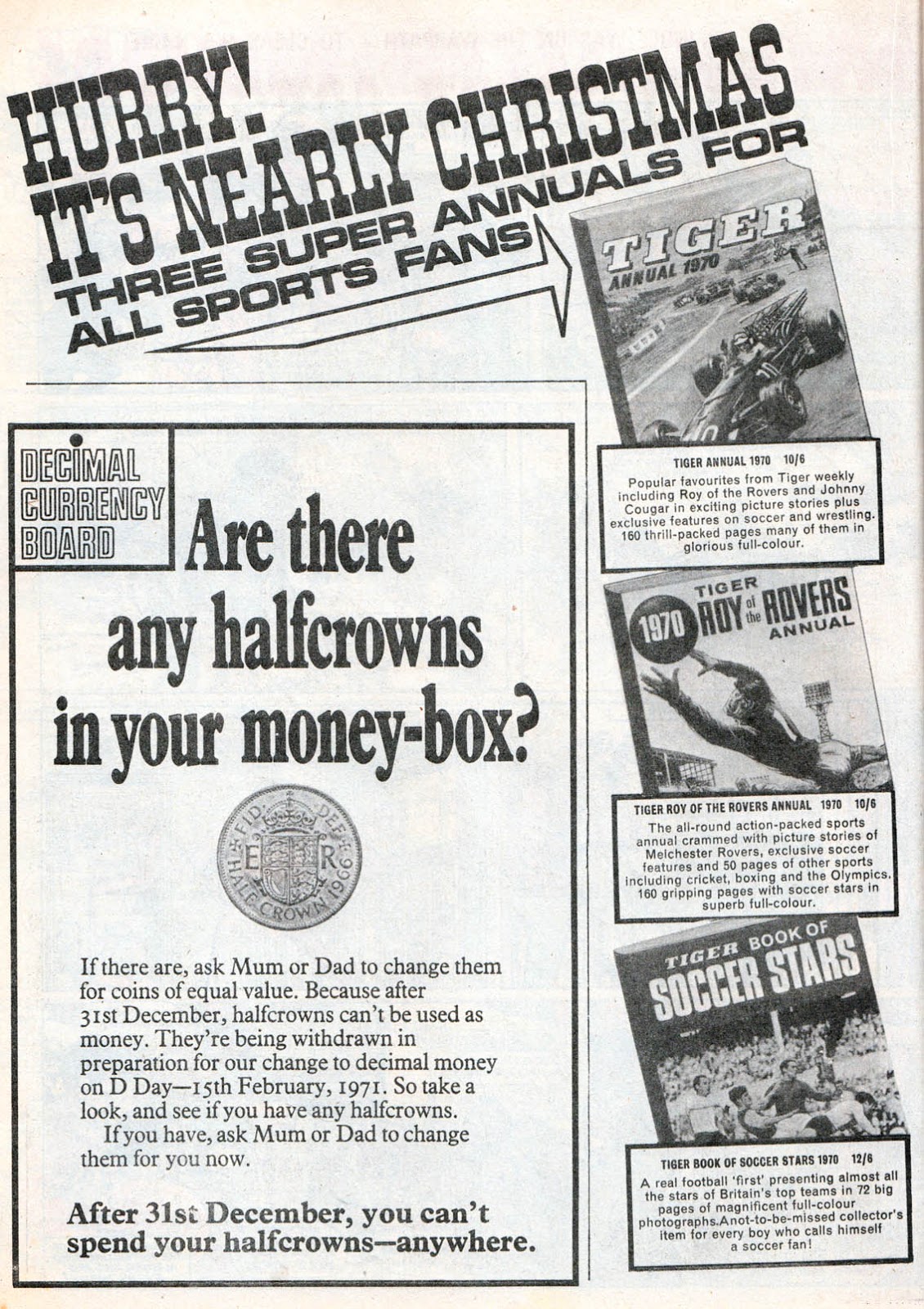
An advert for that year's annuals, plus a notice about the impending change to decimal currency that would come into force 14 months later...
Nosey was Tiger and Jag's single humour strip. The art looks a lot like the work of Chas Sinclair but I'm not sure if it is his or not. (At that time he was freelancing for TV Comic on Basil Brush.)

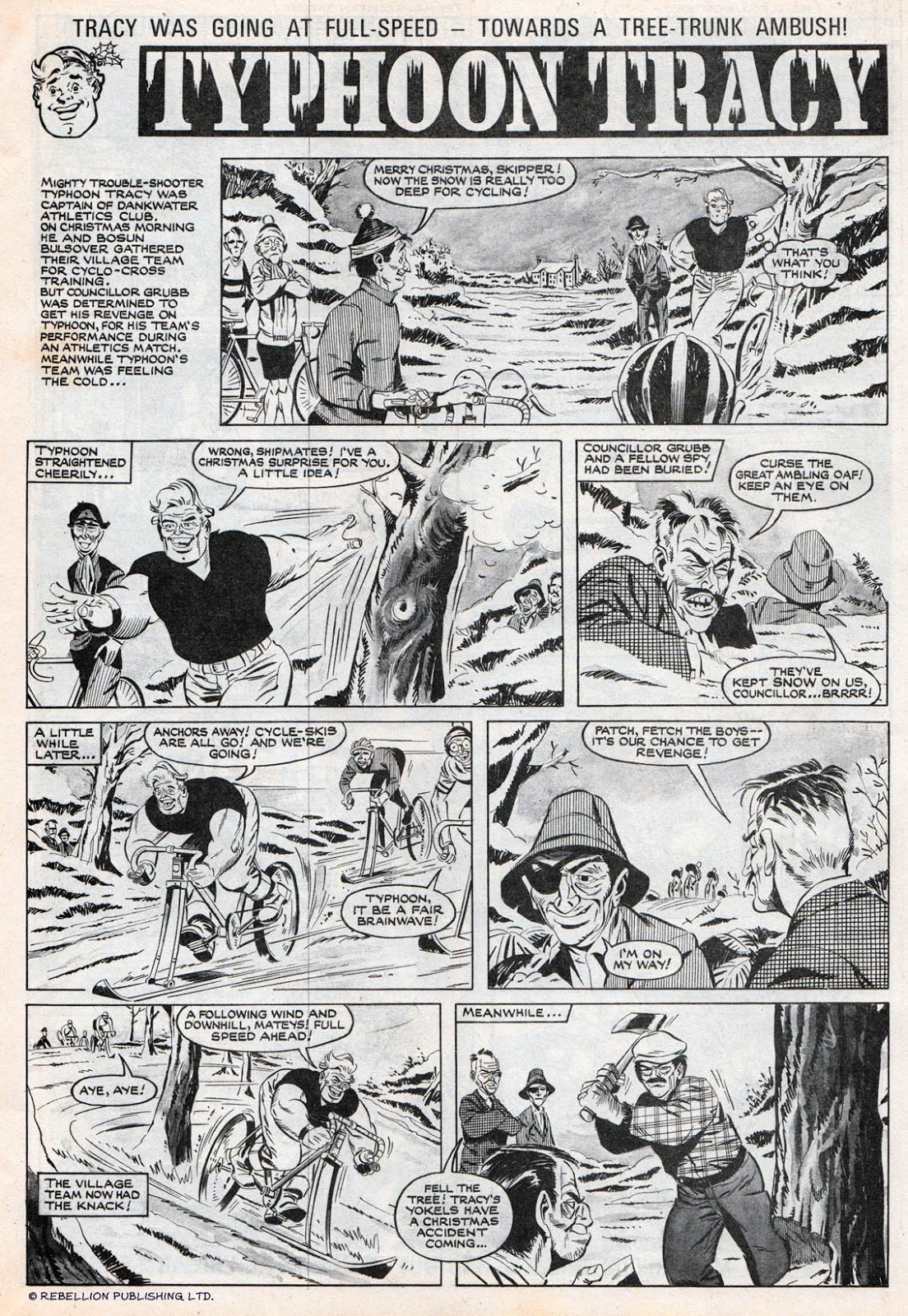
Another snowy strip ending with a Christmas feed, Typhoon Tracy was drawn by Graham Allen, who had previously illustrated many humour pages for the Odhams comics. A skilled artist who could do both funnies and light adventure. 

There'll be another Christmas comic tomorrow! Visit the blog again to unwrap it!


Friday, December 09, 2016

John Gillatt


On Facebook today, John Freeman made the sad announcement that artist John Gillatt has passed away. A popular and prolific artist in the heyday of boys' adventure comics, John Gillatt's work was primarily published in Tiger weekly. He was the original artist on SF strip Jet-Ace Logan for Comet comic in the late 1950s, and remained as one of the artists on the strip when it moved to Tiger in 1959. (The examples shown above are from Tiger dated 26th January 1963.)
Proving himself to be a perfect choice for drawing busy action scenes and a master of figurework and distinctive facial expressions, Gillatt swiftly became one of Tiger's top artists, working on strips such as The Black Archer and Johnny Cougar in the 1960s and then moving on to Football Family Robinson in late 1969 (replacing Joe Colquhoun). 
Later, he became the permanent artist on the long-running Billy's Boots serial for the comic, where his eye for detail and skill at drawing the human figure made him the definitive illustrator on the strip. Billy's Boots also proved very popular in Holland, where it had its own reprint series for which Gillatt painted new covers and supplied additional art. John was also the artist on the Scorer daily strip for the Daily Mirror for several years. 


John Freeman published a tribute to John Gillatt a couple of years ago on the Down the Tubes blog which you can see here:
http://downthetubes.net/?p=14018

No doubt more tributes will be posted online soon to this great comic artist and I'll update this post with links to them as and when.

New tribute to John Gillatt here:
http://downthetubes.net/?p=35570
A 1990 revival of Jet-Ace Logan by John Gillatt.

Sunday, November 16, 2014

The Black Archer (1966 - 67)

The notion of a modern-day Robin Hood type of character isn't new to comics. DC Comics' Green Arrow has been around in one form or another since 1941, (and is now the star of the Arrow TV series) and Marvel's Hawkeye debuted in 1964. With the issue dated 2nd July 1966, Tiger and Hurricane introduced their own version, - The Black Archer.


To be frank, The Black Archer wasn't a very memorable character, but I thought its novelty might interest some of you. Above is the origin story, illustrated by the great Eric Bradbury. 

I only have sporadic issues of Tiger from this period but by the 19th November 1966 issue, The Black Archer had a different artist. The following three pages look like the work of Sandy James to me...


You'll also note that the character has moved away from his original urban vigilante theme into a more fantastic vein, fighting bizarre villains. This was undoubtedly inspired by the success of the Batman TV series. By January 1967, The Black Archer was facing a very peculiar looking character called The Remover...

By now, the artwork was by John Gillatt, another of Fleetway's many top illustrators. Tiger's rotating cover strips meant that it appeared on the front page on at least one occasion (issue dated 18th February 1967)...


As you can see, the scripts were not great, but it was a quirky strip and it featured some very nice artwork so it deserves to be remembered for that at least. If you're interested in seeking it out, The Black Archer ran in Tiger and Hurricane from 2nd July 1966 to 7th October 1967.

Monday, June 18, 2012

This week in 1957: THE COMET

  
The Comet, published by The Amalgamated Press, underwent a few format changes during its 13 year lifespan (1946 to 1959). Initially it was a tabloid comic, but in the 1950s a number of British publishers began approximating the popular American comic book size, and The Comet also adopted that format. From the time this issue saw print, this week in 1957, The Comet had 16 pages 185mm wide by 240mm high. Four of the pages were in full colour (using the three colour dark blue/red /yellow process, but no black) with the rest in black and white.

The cover feature at this time was Buffalo Bill. Westerns were a popular theme in the 1950s so it made sense to follow suit, with Buffalo Bill given a complete seven page story every week. I'm not sure who illustrated this story though I'm afraid.

 
Billy Bunter had a two page strip in The Comet at the same time his strip was also running in Knockout. 


The centre pages ran the historical serial Claude Duval - The Gay Cavalier. (No sniggering at the back there.) The artist Patrick Nicolle is credited by some sources as the artist of this strip but the heavy brushstrokes of this episode don't look like his work to me. Perhaps a fill in? (UPDATE: Possibly by Fred Holmes?)


Jet Ace Logan became a popular character of the era, and later moved to Tiger when Comet merged into it in 1959. Some solid work here by John Gillatt, who had a long career illustrating various strips for Fleetway and IPC such as Football Family Robinson and a long run on Billy's Boots. He was also one of the artists on Scorer for the Daily Mirror.


The Comet also featured a Lone Ranger strip (possibly a reprint), again capitalizing on the Western craze. On the back page, the only light relief in the comic , the Chuckle Club joke page, with a 10 shilling (50p) prize for every joke published. At the foot of the page is a "Great News, Readers" announcement of a new look for The Comet, which from next week would drop the cover strip in favour of a painting.

 
The Comet was presumably aimed at an older reader than most British comics in that the stories featured considerably more text and dialogue than, for example, The Beano or even Eagle. Perhaps this was A.P.'s way of making it seem more literate, defending the comic from the mood of the times which had become suspicious of comics due to the fearmongering whipped up by the anti horror/crime comics campaign. Sadly, the fact that the comic folded two years later might suggest it backfired and that the verbose tales put off the audience they were trying to attract. If anything, comic storytelling of the time was becoming more streamlined, and the heavy word count that The Comet featured was going against such developments. 
Related Posts Plugin for WordPress, Blogger...