The second in our flashbacks to Christmas Past comes in the form of TV Comic No.164, dated 25th December 1954 (but published several days before of course). Back in the early years of this comic, it was aimed at a very young audience, and Muffin the Mule was the cover star, drawn by Neville Main.
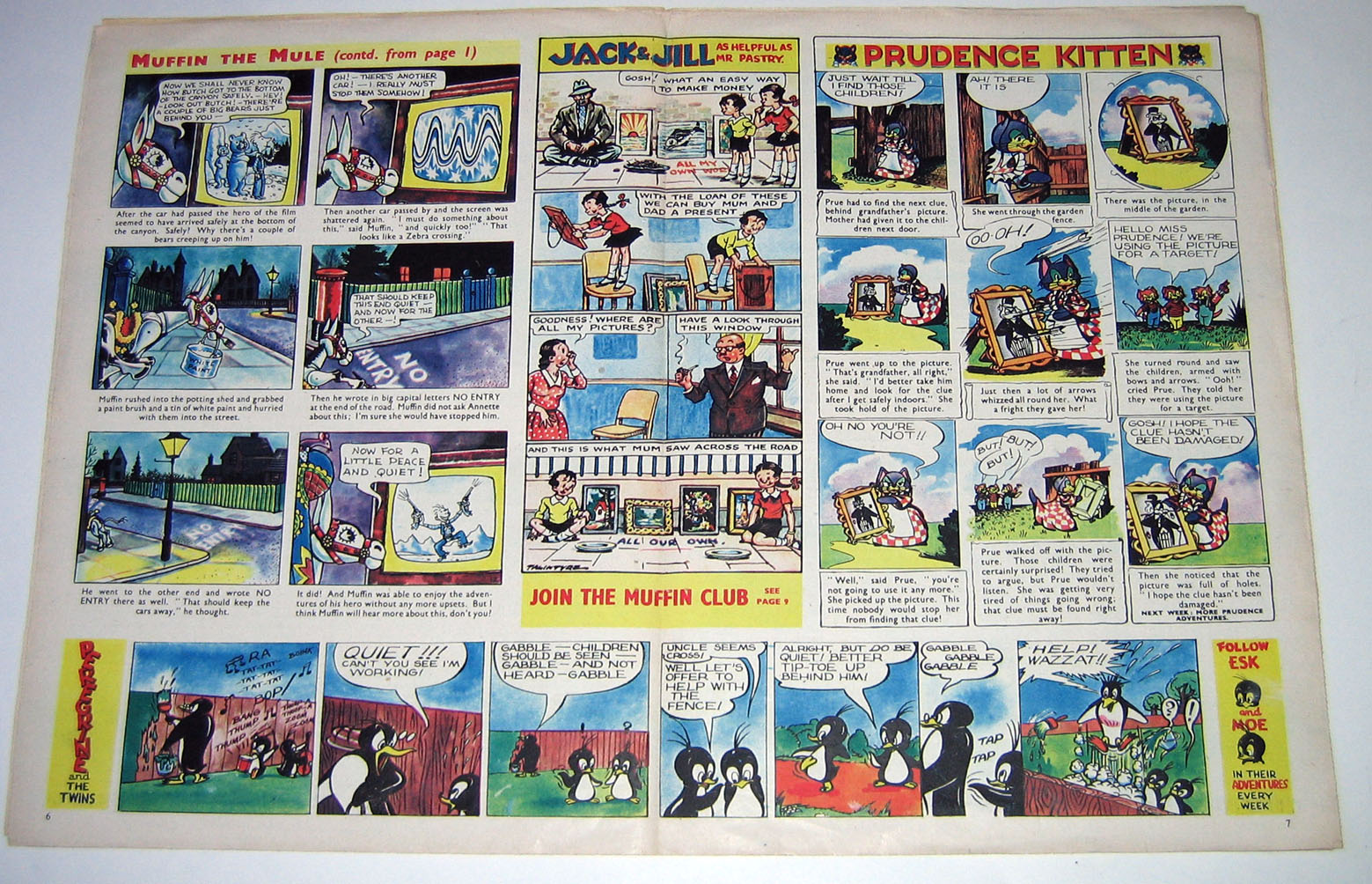
The Muffin strip continued onto the foot of the centre pages, which it shared with three other strips. I have to mention that this issue was in poor shape when I bought it, with tears and chunks ripped out, so please excuse the state of it.
Another popular character in TV Comic was Sooty, based on the glove puppet. He had legs in the comic strip though! Note who the artist was, - Tony Hart. Yes, the same guy who appeared on television for many years, known for Vision On, Morph, and Take Hart amongst other shows.
TV Comic in 1954 had 16 pages, comprised of 8 in colour, 8 in black and white. Here's one of the monochrome pages; the lyrics to Silent Night and a Nativity image by Barbara C. Freeman. You can't get much more Christmassy than that.
The Holland Toffee Twins is, presumably, a sponsored strip by Holland Toffees. Having adverts as comic strips was a nice idea that doesn't seem to be used in UK comics now, although DC Comics in America are currently running ads for Snickers in comic strip form.
Finally in this selection, here's Red Ray, Space Raynger, drawn by Roland Davies. Interestingly, this British superhero was not based on a TV show and was exclusive for TV Comic. He became very popular with readers, and even had his own fan club created by the publishers.
Come back again tomorrow for another Christmas comic from a different year!
If, like me, you read TV Comic in the late 1960s/70s, the first thing you'll notice is how different in tone this early issue from 1952 is. For its first several years, TV Comic was aimed at a younger readership; a nursery comic almost, before growing with its audience a little in the late 1950s and being aimed at 6 to 11 year olds.
One of TV Comic's regular artists throughout much of its run was Neville Main, who illustrated the Muffin the Mule strip on the cover. (Main would later draw the early Doctor Who strips for TV Comic.) Muffin's story continued inside, as one of the strips in the centrespread...
On page two of this "Special 16 page Christmas Number" (usually 12 pages) was a full page party illustration by Hugh Gladwish. This would have made a fine front cover in its own right...
On page 6 was a strip that would have been at home in the traditional funny comics; Tommy Cooper, by Denis Gifford...
TV Comic also included several activity pages and educational articles in its content, such as this one illustrated by Evelyn Morris...
As you'll have noticed, TV Comic was happy to credit its creators, although the strip Mr.Pastry wasn't actually by Richard Hearne. That was the name of the actor who portrayed him...
On the back page was Hank, the puppet of TV ventriloquist Francis Coudrill. Although Coudrill was an artist himself, the strip was written by Graeme Phillips and drawn by Ron Murdoch.
Another year, another festive issue tomorrow!
 This is the issue of TV Comic that would have been on sale exactly 60 years ago this week. Those of you who knew the title in its later years will immediately notice that in its early days (this is issue No.12) TV Comic was pitched at a younger readership, perhaps just above the nursery comics age group.
Published by News of the World Ltd (long before that paper dragged itself into the gutter towards oblivion) the early TV Comic only had 12 pages, but 8 were in glorious full colour thanks to the slick photogravure printing. Even in the early 1950s, such lavish production standards were rare, reserved for such comics as Eagle and Mickey Mouse Weekly, whilst the majority such as Chips, Beano, Film Fun, Knockout etc had to settle for common newsprint and limited colour.
As you can see, the cover strip in 1952 was the hugely popular Muffin the Mule, based on the puppet that the nation's children had taken to their hearts. (These old comics offer a fantastic snapshot into history. Just look at that 1950s TV set!)
The artwork on Muffin the Mule was by Neville Main, who would become a regular on TV Comic, later illustrating the Hartnell Doctor Who strips and other features. The Muffin cover strip continued on the centre pages alongside strips by other artists.
 Mr.Pastry appeared on page 2 of TV Comic back then. (Pastry was a comedy performer, - real name Richard Hearne, - in case you were assuming he was a TV chef.) The artwork is by Lunt Roberts (according to Denis Gifford's Encyclopedia of Comic Characters), providing a nice bit of slapstick sequential art here.
 There were also text stories and articles in TV Comic back then, such as this activity feature. No snickering at the back there please...
 This Tusker & Tikki strip has some very nifty artwork by someone calling himself "Spike".
 With 8 pages of colour you'd have thought they'd have reserved one for Prince Valiant as they were reprinting the American Sunday pages. Sadly not, and Hal Foster's top quality work was reproduced in murky black and white instead, with an instruction for "young artists" to colour it themselves. (Luckily I managed to pluck this issue from the time vortex before any 1950s freckle-faced urchins with compulsory sticking-out ears had crayoned on it.)
 The Tom Puss strip opposite Prince Valiant is another reprint, this time of the Dutch strip Tom Poes by Marten Toonder. I assume this is a chapter of a longer story that was serializing one of the Tom Poes albums.
On the back page was Hank which, like Muffin the Mule, was also based on a puppet series. The lively artwork was by Ron Murdoch.
 For better or worse TV Comic underwent several changes over the years but this early issue shows what a quality product it was in its early stages. Even its logo was clearly designed and contemporary for its time, and the whole comic must have seemed very modern and exciting compared to most comics of the 1950s. Also, with television being in black and white back then imagine the impact the stunning colours of the TV Comic strips must have had on the readers.
A year later in 1953, Amalgamated Press launched a rival in the form of TV Fun, which had charms of its own but failed to last beyond 1959. In the meantime TV Comic continued its steady progress and managed an impressive run of 33 years, ending in 1984.