Comic Scene No.4 will be out this Wednesday, 23rd May, and one of the many articles inside will be a four page retrospective on the artist Roy Wilson that I've written.
Roy Wilson was one of the most influential humour artists in comics, and the feature is illustrated with various panel and covers of his that I scanned from my collection. One piece of artwork I supplied that wasn't used was The Sports Commentor's Nightmare, the frontispiece from the Radio Fun Annual 1952. Rather than let my scan go to waste I thought I'd post it on my blog today for you all to enjoy. (Click on the image to see it larger.) What a fantastic cartoonist Roy Wilson was!
Don't miss Comic Scene No.4 on Wednesday, to read my article (and many other features). If your shops won't stock it (their loss!) you can order it directly from the publisher here:
https://getmycomics.com/comicscene
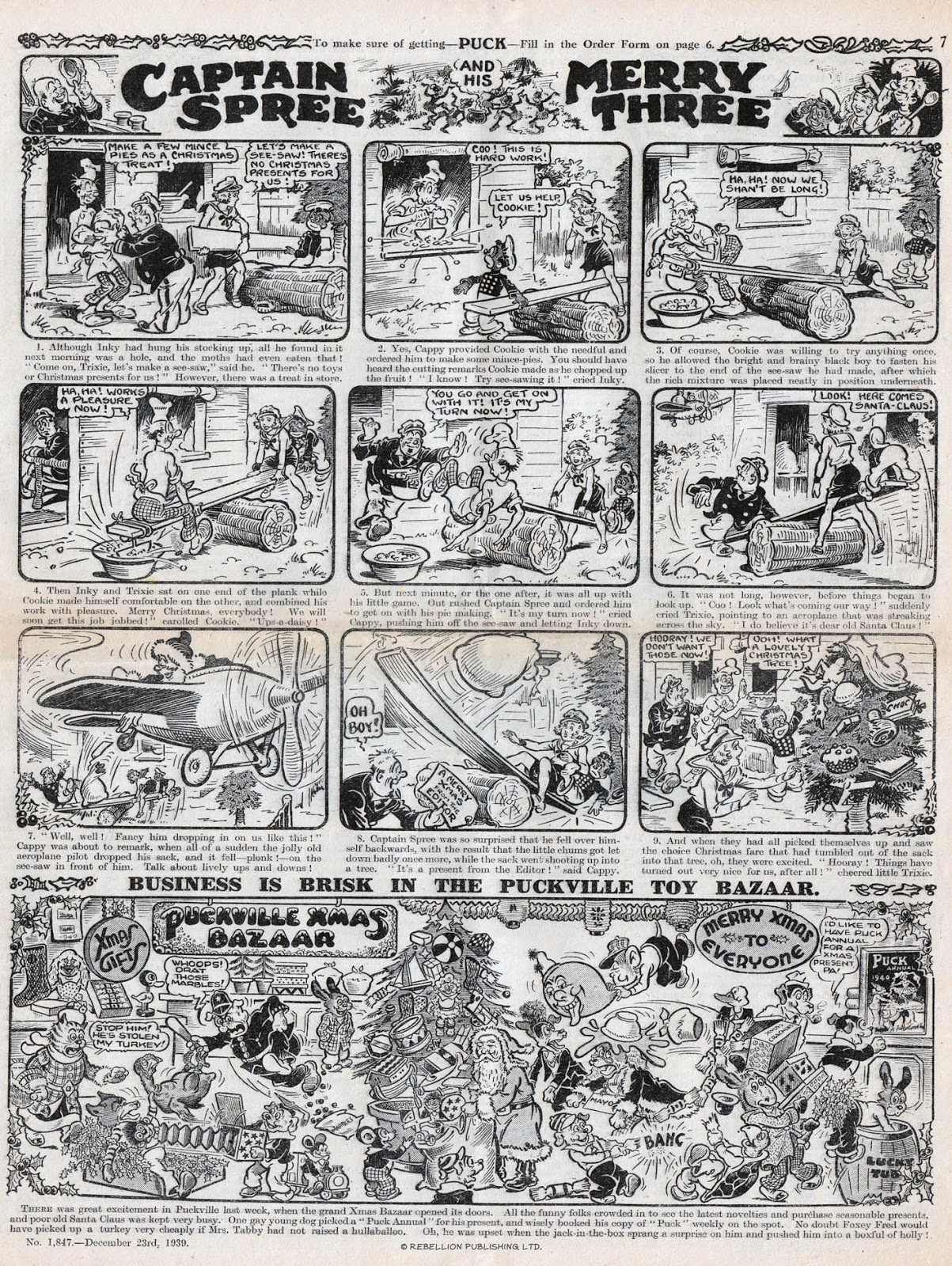
Puck ran from 1904 to May 1940, so this 1939 issue was its final Christmas edition. Published by Amalgamated Press, Puck was an 8 page tabloid, although this festive issue has 12 pages.
I'm not 100% sure who the cover artist is. My feeling is that it's Roy Wilson, but he had so many imitators, due to editors telling other artists to "ghost" him, it could be John Jukes or someone else entirely! I'm betting it's Wilson though.
Inside, Rob the Rover was a popular strip of the time, drawn by Walter Booth.
Captain Spree and his Merry Three is typical of the times, in a bad way, in that it includes a racist caricature character, "Inky". His appearance becomes even more noticeable because Trixie is drawn almost realistically. One positive point is we're told that Inky is a "bright and brainy black boy", which I suppose makes a change from black characters being depicted as dim and slow-witted as shown in other strips.
My research informs me that the Puckville strip at the bottom of that page is by Bert Hill.
Like other comics of the period, Puck contained a balance of strips and prose stories. One of the latter featured Rin-Tin-Tin the famous canine star of the movies...
On the back page, - Dick Drew, the Hunted Cowboy - Fighting for his Own! I don'y know who drew it, but it's highly competent artwork and has seasonal references so I'm including it here.
One of the great injustices of British comics history is that for decades most artists were not allowed to sign their work. Writers also went uncredited. I try to identify strips if I can (and others inform me too) but it really is a disgrace that so many brilliant creators are forgotten now, for no good reason whatsoever.
Another Christmas comic tomorrow, so please join us again!
I did a post on this title a few years ago, but that was a slightly earlier issue. Here are a few pages from Jingles No.571, dated July 25th 1949. Another tabloid-sized comic published by The Amalgamated Press from Fleetway House in Farrington Street, London.
A.P. still dominated the UK comic scene at this time but their rivals in Dundee were proving to be fierce competitors and readers were preferring the more modern-looking Beano and Dandy to comics such as Jingles which were looking quite old fashioned by this time.
Nevertheless, Jingles is a nice lively comic and features some top class cartoonists of the period. The cover strip, Dreamy Dennis, is by Albert Pease I believe.
The adventure strip Strongheart, The Wonder Dog of the Woods, was one of several "heroic dog" strips in comics. (The best remembered being The Dandy's Black Bob.) However, Strongheart preceded Black Bob, and the strip was based on the dog of the same name that starred in films in the 1920s. Sadly, Strongheart was long gone by the time this strip appeared. The comic strip was drawn by Hilda Boswell, one of the few women working in comics back then.
Jolly Jingles, the strip sharing the page with Strongheart, was drawn by George Parlett, brother to Reg Parlett...
Jimmy Jolly and his Magic Brolly was drawn by the master of golden age slapstick comics, Roy Wilson. Other A.P. cartoonists of the time were instructed to mimic Wilson's style, which is why it's sometimes difficult to identify who drew what. Roy Wilson's style influenced the look of comics from A.P., and later Fleetway and IPC, for years, and elements are still noticeable today. (I've certainly absorbed some of his techniques into my style but I'd never consider myself in his league of course.)
On the back page, another adventure serial. Nicely illustrated, but I'm afraid I don't know who drew it. I feel I should, as the style looks familiar. Can anyone identify the artist?
Jingles ran from 1934 to 1954, then merged into TV Fun. The copyright to this material would now be part of Rebellion Publishing's recent acquisition I believe. It would be nice to see some strips from this period back in print, just for the sake of the heritage of British comics if nothing else. Roy Wilson certainly deserves a collection of some of his work. However, one has to be realistic and it's unlikely that many readers would actually buy such a book. People tend to mainly be interested in the sphere of their own nostalgia unfortunately. Personally, I've always found the whole history and development of comics to be fascinating, but there aren't enough of us to support reprints of material of this vintage. Or are there? What do you think?
Here's my final choice in this year's Christmas selection, and instead of another weekly comic I thought I'd show some pages from an annual instead. Golden Fun and Story Book 1939 (published 1938) was the first annual for Golden comic weekly. Sadly there'd only be one more book a year later before the effects of World War 2 led to cutbacks on paper and the end of several comics.
Many children would have had this book as a present on Christmas Day 1938, so its 108 pages included some festive strips and references, such as on the cover.
The book featured a packed mixture of humour and adventure strips and prose stories. I suspect some were reprints from the weekly, as was often the practice of publisher Amalgamated Press. Here's a selection of a few of the interior strips, some festive, some not...
The Mountain Raiders strip was illustrated by Reg Perrott, a standout adventure artist of the times whose work still looks impressive today. Tragically, Reg's career was cut short with his death in 1947...
The Lieutenant Daring strip featured some pleasant artwork by Roy Wilson, but also sadly some unpleasant racist slurs, typical of the period...
I'm not sure who drew the other strips, but if anyone out there does know, please leave a comment.
Towards the back of the book there was an advert for the weekly Golden comic...
...and the back cover featured an advert for beef suet! A bizarre choice of ad in a children's annual by modern standards but quite common back then.
If you want to see what the weekly Golden comic was like, click on this link to see an old posting of mine...
https://lewstringer.blogspot.co.uk/2009/12/vintage-colour-comics-golden-no125-1940.html
••••••••••••••••••••••••••••••••••••••••••••••••••
I hope you've enjoyed this year's selection of Christmas comic pages. Thanks for dropping by. I'm taking a break from blogging for a few days now but I wish you all a Merry Christmas of slap-up feeds, and a Happy New Year!
Fleetway Publications launched Valiant No.1 on Saturday 29th September 1962 (cover dated 6th October). Like Buster, launched two years earlier, Valiant was part of Fleetway's determination to modernise the comics line for a new era, with a bolder, cleaner look than the dated (and long-dead) comics such as Comic Cuts and Chips that had been produced by their predecessors The Amalgamated Press. Valiant actually replaced Film Fun on the schedule when that long-running comic merged into Buster a month before Valiant debuted. There was no doubt that Fleetway intended to clear the decks for their new style comics.
The cover of Valiant No.1 was bold and effective; a single image of Captain Hurricane welcoming the readers, set against primary colours. I've already shown the first episode of Captain Hurricane in an earlier post (see here) so I won't show that again, but I was lucky to recently win Valiant No.1 on eBay so I thought I'd show a few of the other pages today.
Valiant's 32 pages featured adventure strips with a few humour pages added to balance things out. One of those funnies was The Nutts, drawn by Angel Nadal, that would prove so popular it would remain in the comic until the final issue in 1976.
One of the most memorable series that appeared in the comic was The Steel Claw, written by Ken Bulmer and illustrated by Jesus Blasco. This atmospheric first episode reveals how Louis Crandell gained the power of invisibility. In these early tales, Crandall was a villain! When the strip proved popular, it was decided he should become a hero, and his evil ways were explained away as the result of the lab explosion. However, as can be seen in this first episode, Crandall was resentful and greedy before the accident...
Valiant No.1 featured a high standard of talent, including the great Roy Wilson illustrating Percy the Problem Child. Wilson was considered the main humourist of the old A.P. comics, with the "house style" that others were encouraged to emulate. By 1962 he was sadly nearing the end of his life (he passed away in 1965) and his style was no longer flavour of the day of the fickle comics industry but he could still draw as well as anyone in the business.
The centre pages of Valiant's first issue were taken up with episode one of To Glory we Steer, distinctively illustrated by Eric Parker. I must confess I found his style too 'heavy' for my liking as a child, but now I can appreciate what a skilled and unique artist he was.
The editor's letter welcomed the readers on It's All Yours, a page inviting kids to send in their jokes and anecdotes. But how did they get submissions for the first issue? It was hardly a trade secret; they were simply made up as an example to show they type of material they wanted readers to submit. (EDIT: On the other hand, some jokes were spare ones that had been submitted to Buster. See Phil Elsham's comment below. Thanks for the info, Phil!)
The struggles of working class heroes were always a good theme for British comics, and in Valiant No.1 we had Kid Gloves, the story of a boxer from the rough end of town. Superb artwork by Geoff Campion, one of Fleetway's finest artists.
Campion also drew the back cover feature, Famous Fighters, that would graduate to the front cover after the first few issues.
Valiant got off to a great start with this issue, with a strong line-up by the top talent in the business. It's no wonder the comic lasted as long as it did, running for 14 years in total before merging into Battle Picture Weekly.
...and if you'd like to see a few pages from the second issue of Valiant, you'll find them here:
https://lewstringer.blogspot.co.uk/2017/09/looking-back-at-valiant-no2-1962.html
Whitsun was a bigger deal in years past than it is today, and 80 years ago the comics of the Amalgamated Press used it as the theme for that week's issues. I've previously shown the Whitsun issue of Jolly Comic for 1937 (click here) and now here are a few strips from The Funny Wonder of the same week. The comic is scanned from my collection.
Funny Wonder had 8 tabloid-sized pages, all printed in black ink on green paper for 1d. The wonderful holiday theme logo illustration and Pitch and Toss cover strip is the work of Roy Wilson I think. (Might be by one of his imitators but I'm sure it's a Wilson page.)
Inside, Merry Moments with Marmy and his Ma sees mum and son visiting a fair for the holidays. Note the "Fat Boy" attraction; a depiction of times when the "Freak Show" was a voyeuristic attraction at fairs. Art by Wally Robertson I believe.
Charlie Chaplin had appeared on the cover of the comic for years but by 1937 he was one of the centre-spread strips. Art by Bertie Brown.
Sally, the Sunshine of Our Alley, had a resourceful girl as the lead, and the title of the strip was of course inspired by the 1931 film Sally in our Alley starring Gracie Fields.
The comic included a cut-out badge for readers to become part of "The Funny Wonder Secret Society", but stipulated that only regular readers could wear it. (That excludes all of us then, unless we have a bound volume of issues to read.)
Fifty percent of the issue was taken up with prose stories and, on the back page, the only adventure strip in the comic; Tim McCoy. Those speech balloons are a bit shouty!
I hope you enjoy reading this summer issue from 80 years ago. If you have a laptop or tablet, why not sit in the sunshine and enjoy a good read? (22 degrees C here at the moment!)
By 1967, Buster had reduced its size from its original tabloid format down to 32mm x 23mm (the same size as Smash!, Pow! and Wham! were at that point) but this was still larger than most comics. With 36 pages for 7d it was good value, even though only the front cover was in colour. Speaking of which, Angel Nadal provided the cover strip shown here, although I'm not sure if it was him or a staff artist who did the larger picture.
Inside, we were treated to some nice material by Leo Baxendale, who had quit the Odhams comics a year earlier to freelance for the better-paying Fleetway titles. Here's The Cave Kids, avoiding the anomaly of Christmas in prehistoric times but still cleverly managing to do a seasonal story involving a sledge and snow...
A sledge also features in the Charlie Peace story, drawn by Jack Pamby. It seems bizarre now that one of Buster's longest-running strips was based on a real-life murderer, although for the purposes of the strip, Charlie is just a loveable rogue and bumbling thief. All the same, it was a very strange inclusion in a children's comic...
Andy 'n' Fred was drawn by veteran artist Cyril Price. I've always liked his work. Price also drew many episodes of Georgie's Germs at this time for Wham!
Running across the centre-spread was The Pirates, another strip by Leo Baxendale. Nice work, and a pity it wasn't in full colour.
Attempts at doing British superheroes didn't always meet with success. Thunderbolt the Avenger isn't as well remembered as Billy the Cat or Marvelman, but he had a run of just over two years in Buster...
This Harry Secombe strip from the back of this issue of Buster was actually a reprint from Film Fun, and the artist, Roy Wilson, had passed away two years earlier, but any work by Wilson is worth showing...
I hope you're enjoying these Christmas classics! Click on the images to see them larger. More soon!