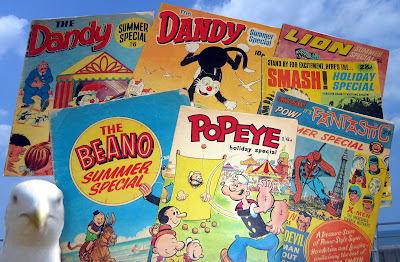
 A recent blog on The Guardian website lamented the demise of the traditional comic Summer Special, and they were right to do so. After almost fifty years, the bumper seasonal editions seem to have finally ceased to be. D.C. Thomson hung on the longest, but the Beano Summer Special closed a few years ago, replaced by the monthly BeanoMAX, and last year's Dandy Summer Special appears to have been the last one.
What went wrong? Apparently today's retailers dislike them because they occupy valuable shelf space for too many months. The other reason is down to how comics themselves have evolved.
A recent blog on The Guardian website lamented the demise of the traditional comic Summer Special, and they were right to do so. After almost fifty years, the bumper seasonal editions seem to have finally ceased to be. D.C. Thomson hung on the longest, but the Beano Summer Special closed a few years ago, replaced by the monthly BeanoMAX, and last year's Dandy Summer Special appears to have been the last one.
What went wrong? Apparently today's retailers dislike them because they occupy valuable shelf space for too many months. The other reason is down to how comics themselves have evolved.
(UPDATE 2021: Summer Specials took a temporary hiatus but they returned, and the Dandy and Beano Summer Specials have been a fixture in WH Smith for a few years now, albeit in a new A4 size 68 page bookazine format. Rebellion have also published many specials since they acquired the rights to the old Fleetway/IPC comics. Bear in mind this article was written in 2009 before the specials returned.)
With regular UK comics now being full colour glossies, how can a Summer Special stand out as "special"?
The idea of weekly comics having a once-yearly Summer Special spin-off only appears to have gained popularity in the 1960s. There was a glossy colour Mickey Mouse Holiday Special as early as 1937 (priced 6d - a small fortune for a kid back then) but British comics of pre-war years would sometimes have a themed summer edition as part of their regular run, in the usual 8 page format. Here's an example from 1934; the "Jolly Summer Holiday Number" of The Joker, published by Amalgamated Press. Artwork by John L. Jukes...
 ...and the "August Holiday Number" of A.P's Funny Wonder from 1939, with a wonderful cover strip by the great Roy Wilson...
 Inside that same issue of The Funny Wonder, Charlie Chaplin indulges in some seaside slapstick...
 As the 1960s rolled around, Fleetway launched a Jack and Jill Summer Special for the pre-school audience in 1961. The following year saw Odhams launch an Eagle special and also in 1962 TV Publications Ltd published a TV Comic Holiday Special; a 48 pager with mostly new material. Not to be left out, D.C. Thomson tested the market with a combined Dandy/Beano Summer Special in 1963 featuring reprints from the weeklies. That same year also saw City Magazines publish a Huckleberry Hound/Yogi Bear Summer Extra. These sharply printed photogravure publications established the format for such Specials for the next few years.
The Specials must have proven to be very successful. The following year (1964) saw Thomsons devote individual Summer Specials to both The Dandy and The Beano with brand new material, and TV Comic continued with its Specials too.
As the 1960s rolled around, Fleetway launched a Jack and Jill Summer Special for the pre-school audience in 1961. The following year saw Odhams launch an Eagle special and also in 1962 TV Publications Ltd published a TV Comic Holiday Special; a 48 pager with mostly new material. Not to be left out, D.C. Thomson tested the market with a combined Dandy/Beano Summer Special in 1963 featuring reprints from the weeklies. That same year also saw City Magazines publish a Huckleberry Hound/Yogi Bear Summer Extra. These sharply printed photogravure publications established the format for such Specials for the next few years.
The Specials must have proven to be very successful. The following year (1964) saw Thomsons devote individual Summer Specials to both The Dandy and The Beano with brand new material, and TV Comic continued with its Specials too.
 Trumpeting the comics as "special" certainly wasn't hyperbole. Freed from the limitations of the weekly newsprint format the Summer Specials offered painted full colour strips bursting with life. (Although my copy of the first Dandy Summer Special from 1964 shown here is unfortunately browned with age.)
 This was the perfect time for the Summer Specials to arrive. With The Dandy going through a peak in 1964, the Special featured some of the best artists in the business. Here's Eric Roberts on Dirty Dick and Ken Reid on Big Head and Thick Head...
 ...and Bill Holroyd on Joe White and the Seven Dwarfs...
 Charlie Grigg was the resident cover artist, always producing memorable images of Korky the Cat. Here's the cover for the 1966 edition ( a bit torn, sorry). The image featured an inventive but simple novelty. By holding the cover in front of your eyes and rotating it it seemed as though Korky's bike wheels were spinning...
 ...and another Grigg cover for the 1969 issue...
 The back cover of the same special is a fine example of how the quality printing gave artists the opportunity to go to town with colour work, as this Korky the Cat strip by Charlie Grigg demonstrates. (Korky's brutal remark to the mice in the final panel is a cracker, and shows how much more abrasive the dialogue could sometimes be in comics of the 1960's)...
 The Beano Summer Special had the benefit of the great Dudley Watkins on covers for its first few years. Here's the cover for the 1967 edition...
 (Don't worry folks. Biffo wasn't plunging to his doom after all. The back cover showed he was only diving towards a trampoline!)
Inside that same issue, a fantastic centrespread story featuring The Iron Fish...
(Don't worry folks. Biffo wasn't plunging to his doom after all. The back cover showed he was only diving towards a trampoline!)
Inside that same issue, a fantastic centrespread story featuring The Iron Fish...
 Usually the centre pages would be reserved for a board game, ideal for those wet days sat inside a holiday guest house. Here's one by Eric Roberts from the Dandy Summer Special 1969...
 The Summer Specials were clearly intended to be read by kids whilst on holiday, and the strips reflected the holiday environment of the 1960s, whether it be a journey in a train carriage...
 ...or the favourite destination of the time, Blackpool...
 ...watching a Punch and Judy Show...
 ...building a sandcastle...
 ...going on the fair...
 ...having a donkey ride...
 ...or simply relaxing in the sun with a cigar. (Er, well, maybe the readers' Dads could relate to that one!)...
 Both the Dandy and Beano specials featured 32 glossy tabloid pages; quite a leap from the 16 newsprint pages the weekly editions had back then. City Magazines also seized the potential of the Summer Special by issuing the 48 page whopper TV21 Summer Extra in 1965 which featured a free gift (the "Cosmic Capers Kit") giving it the advantage over its rivals.
Here's the cover to the 1966 edition...
Both the Dandy and Beano specials featured 32 glossy tabloid pages; quite a leap from the 16 newsprint pages the weekly editions had back then. City Magazines also seized the potential of the Summer Special by issuing the 48 page whopper TV21 Summer Extra in 1965 which featured a free gift (the "Cosmic Capers Kit") giving it the advantage over its rivals.
Here's the cover to the 1966 edition...
 Inside, the adventure strips had little connection to a holiday theme but at least the "special" aspect was evident in futuristic articles such as this spread (by Eric Eden I think)...
 Odhams also joined the party, releasing the Fantastic Summer Special in 1968, a 52 pager. Although mostly Marvel reprint, it did feature a handful of new pages including The Cloak by Mike Higgs...

 Fleetway decided to hop on the bandwagon on Thursday June 23rd 1966 with the publication of the Valiant Summer Special...
 This policy continued when Fleetway came under IPC control in 1968. The format IPC chose was different to the now-standard tabloid glossy. Instead, they went for quantity (sometimes over quality) with chunky 96 page specials, mostly in black and white. Here's the Lion Summer Special for 1969...
 A large percentage of pages in the IPC specials were filled up with reprints from old Fleetway weeklies, sometimes with the characters' names changed in a futile attempt to make the strips seem new. However, the reprints were not entirely unwelcome as they collected together serials into nice complete chunks (albeit edited for space). Ideal summer reading indeed.
Here's the first Buster Holiday Fun Special, (1969), with a cover by Reg Parlett...
A large percentage of pages in the IPC specials were filled up with reprints from old Fleetway weeklies, sometimes with the characters' names changed in a futile attempt to make the strips seem new. However, the reprints were not entirely unwelcome as they collected together serials into nice complete chunks (albeit edited for space). Ideal summer reading indeed.
Here's the first Buster Holiday Fun Special, (1969), with a cover by Reg Parlett...
 Reg also contributed new material inside, including this seaside two pager featuring Freddie (Parrot Face) Davies, a popular stand up comic of the period...
 A striking Mike Western cover to the Valiant and Smash Summer Special 1971...
 Inside that same edition, Banger and Masher, an often overlooked Ken Reid strip...

 TV Comic continued its run of Holiday Specials throughout the Sixties and right up to 1986. Here's the cover to the 1970 edition by Dick Millington...
 Inside, the traditional board game, with artwork by Barry Glennard...
 From these early days, the Summer Special became a familiar sight in newsagents throughout the 1970s, 1980s, and 1990s. Seaside resorts would order extra copies as they were guaranteed sellers. (I remember bookstalls along Blackpool's prom selling them in the Sixties.) So popular were the specials that they'd often carry on for years after the parent comic had folded.
Sadly, the demise of the specials has been on the cards for several years and now, with the format eclipsed and sometimes bettered by the regular comics themselves there seems no place for them in the 21st Century. A great shame, as for many of us they definitely made our summers special.
Further reading:
What became of comics' summer specials: A blog on guardian.co.uk by David Barnett:
http://www.guardian.co.uk/books/booksblog/2009/jul/13/comics-summer-specials
Summer Special cover gallery:
http://www.comicsuk.co.uk/Specials/SpecialWhole.asp?FirstTime=Yes
From these early days, the Summer Special became a familiar sight in newsagents throughout the 1970s, 1980s, and 1990s. Seaside resorts would order extra copies as they were guaranteed sellers. (I remember bookstalls along Blackpool's prom selling them in the Sixties.) So popular were the specials that they'd often carry on for years after the parent comic had folded.
Sadly, the demise of the specials has been on the cards for several years and now, with the format eclipsed and sometimes bettered by the regular comics themselves there seems no place for them in the 21st Century. A great shame, as for many of us they definitely made our summers special.
Further reading:
What became of comics' summer specials: A blog on guardian.co.uk by David Barnett:
http://www.guardian.co.uk/books/booksblog/2009/jul/13/comics-summer-specials
Summer Special cover gallery:
http://www.comicsuk.co.uk/Specials/SpecialWhole.asp?FirstTime=Yes
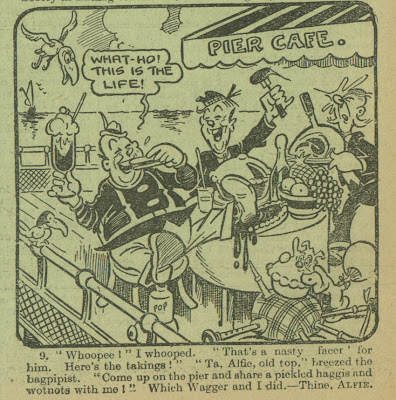 Thanks to Ray Moore for the updates and corrections on the 1961/62 information.
UPDATE: Some publishers have launched the Summer Annual, - hardback books in the traditional children's Christmas annual format, albeit thinner. Egmont currently have several out, tied into licensed properties, including the Power Rangers Super Legends Summer Annual and the Disney Princess Summer Annual.
(My thanks to Rik/KlownKrusty for this info.)


 Ryan's work in television continued in the 1970s when he devised Sir Prancelot and Mary, Mungo and Midge. The rights to Captain Pugwash were bought by HIT Entertainment in 1997 and a brand new Captain Pugwash cartoon series was created, this time more sophisticated, but somehow lacking in the original charm.


