I recently reviewed the new book The Pictorial Guide to British 1950s Sci-Fi & Horror Comic Books which is an informative showcase of hundreds of covers from that era but if you want to know what the actual stories were like Great British Fantasy Comic Book Heroes is an excellent companion volume.
Published by Ugly Duckling Press Great British Fantasy Comic Book Heroes is a hefty tome; a large format hardback containing 464 black and white pages of originated British hero strips from UK independent comics of the 1940s and 1950s. The compilation has been assembled by Phil Clarke and Mike Higgs (Mike also drew the cover) and is a wonderful compendium of characters long forgotten. For those of you who have wished for a collection of old British strips, this is ideal.
 The book kicks off with a 10 page introduction detailing the circumstances which gave birth to these comics. It tells of how paper rationing during and after World War 2 imposed restrictions on established publishers but newcomers were exempt from the paper quota restrictions and were able to turn out titles on any paper available to them. By 1945 the government had also restricted the publication of new comics but the small publishers got around this by slightly changing the titles of their comics so they appeared like new titles to eager readers. Thirsty for American comics that were no longer being imported into the UK due to the war, kids lapped up the British reprints and home-grown superheroes. The article then moves on to focus on individual characters, adding more background to the strips selected and, where known, naming the creators involved.
 Considering that many of these comics suffered from cheap printing, Mike Higgs has done a splendid job on restoration for this book. The fact that the strips appear considerably larger than their original published size is also very welcome. There's certainly a lot packed into the book as those old strips usually only ran to a few pages. The tone of the stories is certainly cheesy but that's all part of their charm. Collectors will be particularly interested in the early work of people such as Joe Colquhoun, Denis Gifford, Ron Turner and Denis McLoughlin.
 Some of the British superheroes were clearly knock-offs of American characters. Marvelman (who is represented by a couple of strips in the book) is the well known one but there were others even more blatant such as Mr.Apollo whose costume was virtually identical to the one worn by Captain Marvel. However that only adds to the curiosity value of the strips in my opinion. It's good to see humour strips represented too, such as the distinctive work of Harry Banger on Stoogie the Super-Man...
 One artist who I think was a great loss to the industry when he quit comics was Bob Monkhouse. One can't blame Bob for one moment for following his fortunes elsewhere but his artwork is definitely worth a look. This book collects one of his complete Tornado strips from Oh Boy! Comics, notorious for its phallic alien designs. How Bob got away with that remains a mystery to this day...
 Many of the stories are lightweight in nature, with the heroes thwarting crooks or fighting alien menaces, so it came as a surprise to see one strip dealing with social issues. In Mick Anglo's Captain Miracle story Way Down South, the heroes battle the Ku Klux Klan in a tale opposing racism. Unfortunately the way the heroes go about it is a bit embarrassing today (they black up to lure out the racists) but its heart is in the right place.
 Now for the price of the book. At £75 it's not cheap, however you have to bear in mind that this is a very limited collectors edition. Only 100 copies have been produced, making this a very scarce item indeed. (Considering that the Marvel Masterworks, with higher print runs, cost around £40 for around 280 pages the price of this book doesn't sound so bad.) You also get a free gift, - a randomly selected genuine 1950s independent comic. (I got Merry Maker No.3.)
You're unlikely to find this book in any bookshops due to its rarity but you can buy it directly from Blasé Books at £75 post free (UK only).
Send a cheque for £75 sterling payable to Blasé Books at:
BLASÉ BOOKS,
Hazelwood,
Birchfield Road,
Redditch
B97 6PU
United Kingdom
Alternatively you can order it via PayPal. £75 to blasebooks@aol.com
Please note: The post free price is only for UK customers. If you live outside the UK please e-mail Blasé Books at the aforementioned address for postage costs to your country.
 Here are the details for the latest four Commando comics that are in the shops now, priced £1.50 each. Thanks again to editor Calum Laird for providing the info...
Commando No 4463: The Improbable Mission
Second-Lieutenant Clement Cleveley of the Army Educational corps was a real boffin. A research student before the war, his mathematical speciality was probability theory…which didn’t really fit with anything in service life.
As it turned out, that wasn’t quite the case which was how, instead of peacefully working at a classroom blackboard, Clement ended up charging around the desert dodging bullets with a bunch of crack SAS men.
Script: Alan Hebden
Art: Manuel Benet
Cover: Manuel Benet
 Commando 4464: Night And Fog
In Occupied Europe during the Second World War, dawn raids and midnight arrests became regular occurrences. They were feared by all the occupied peoples but soon they began to lose their ability to invoke terror.
That’s when an evil Nazi scientist decided that it wasn’t enough just to arrest people. He wanted to make them disappear into the…
Night and Fog
Script: Alan Hebden
Art: Morahin
Cover: Janek Matysiak (Not Ian Kennedy as it says in the credits grenade!)
 Commando 4465: Terror Zone
It started as a routine training patrol to test five top Aussie recruits — until their radio packed in and their NCO was killed in an accident.
Then the dense New Guinea jungle became a terror zone as a bullet flew from out of the shadows. Someone — or something — was trying to kill them…but there wasn’t supposed to be an enemy for thousands of miles!
Introduction by Calum Laird, Commando Editor
Commando fans have always held Carlos Pino’s artwork in high regard, and rightly so. Here he brings the clammy jungle and a band of dishevelled Japanese to life in a few strokes of the pen and brush.
He’s giving form to a story by another long-serving Commando regular, Mike Knowles, whose plots have entertained for long enough to earn him a long-service medal and a well-deserved retirement.
Phil Gascoine did a limited number of Commando covers, but every one was a little gem — even when he had to show an all but invisible figure in the background.
Terror Zone, originally Commando No 2673 (June 1993)
Script: Mike Knowles
Art: Carlos Pino
Cover: Phil Gascoine
 Commando 4466: The Lion’s Den
…that’s where safe-cracker turned secret agent Danny Gregg was headed, to wrest secrets from deep within a Nazi lair.
And he had to succeed. For Danny the reward would be a pardon from his criminal past. For Britain it could mean the difference between victory and defeat!
Introduction by Calum Laird, Commando Editor
At the heart of every Commando story is just that, the story. And here Bernard Gregg, who wrote almost 100 Commando tales between 1972 and 1999, weaves a cracking plot. He takes the “safecracker given the chance to go straight” idea and gives it a fresh twist…or two.
He’s ably complemented by artist Janek Matysiak whose detailed artwork and envelope-pushing layouts really bring things to life. Nearly 20 years later, Janek’s still working for Commando doing covers, but this black and white work is up there with the best of them.
The Lions Den, originally Commando No 2632 (January 1993)
Script: Bernard Gregg
Art: Janek Matysiak
Cover: Janek Matysiak
Visit the website at: http://www.commandocomics.com
 If you thought that reprints of American comics began in Britain with Marvel UK in 1972, or even Odhams and Alan Class in the 1960s, this book will be a revelation. The Pictorial Guide to British 1950s Sci-Fi & Horror Comic Books is a chunky 288 page full colour softback on quality paper compiled by comic historian Mike Morley.
 Here you'll find information on numerous UK comic books of 60 years ago including Captain Marvel, Race for the Moon, The Human Torch, Adventures into the Unknown and many more, some very rare or even forgotten.
 There were dozens of different titles and not all of them contained American reprint. Many were home grown British comics too, such as the Tit-Bits Science Fiction Comics with fantastic artwork by Ron Turner.
 The book contains hundreds of sharply reproduced covers (and some interior pages) showing the sheer scale of the output of comics back then. Traditional British comics and story papers are also mentioned, when they fit the book's remit, such as Comet, Adventure, and Lion.
 Marcus Morris may have created Eagle as an antidote to comics such as this but, as people who were kids back then will tell you, readers often didn't choose between Eagle or horror comics, - they bought both! Sadly, many of these comics were short lived, when, as the author tells us, the witch-hunt against comics in the UK spearheaded by the National Union of Teachers put such comics out of business as publishers feared prosecution if they continued. Dark times indeed.
 This book is a valuable asset for anyone genuinely interested in the history of comics. It covers a fascinating area of publishing that has often been overlooked so it's good to fill in the gaps in one's knowledge with something like this. Author Mike Morley keeps his writing tight and sticks to the facts, providing solid information without bogging it down with conjecture or dull story synopsis. The design of the book, by Mike Higgs, is also straightforward and clear, and packs a lot in for your money.
 The Pictorial Guide to British 1950s Sci-Fi & Horror Comic Books can be obtained post free in the UK by sending a cheque in Sterling for £14.95 payable to Blasé Books at:
BLASÉ BOOKS,
Hazelwood,
Birchfield Road,
Redditch
B97 6PU
United Kingdom
Alternatively you can order it via PayPal, also for £14.95 (Sterling) to blasebooks@aol.com
Please note that this post free price only applies to orders in the UK. If you live outside of the UK and want a copy please e-mail Blasé Books at the aforementioned e-mail address and they'll tell you how much postage will cost to ship the book to you.
 This is the issue of TV Comic that would have been on sale exactly 60 years ago this week. Those of you who knew the title in its later years will immediately notice that in its early days (this is issue No.12) TV Comic was pitched at a younger readership, perhaps just above the nursery comics age group.
Published by News of the World Ltd (long before that paper dragged itself into the gutter towards oblivion) the early TV Comic only had 12 pages, but 8 were in glorious full colour thanks to the slick photogravure printing. Even in the early 1950s, such lavish production standards were rare, reserved for such comics as Eagle and Mickey Mouse Weekly, whilst the majority such as Chips, Beano, Film Fun, Knockout etc had to settle for common newsprint and limited colour.
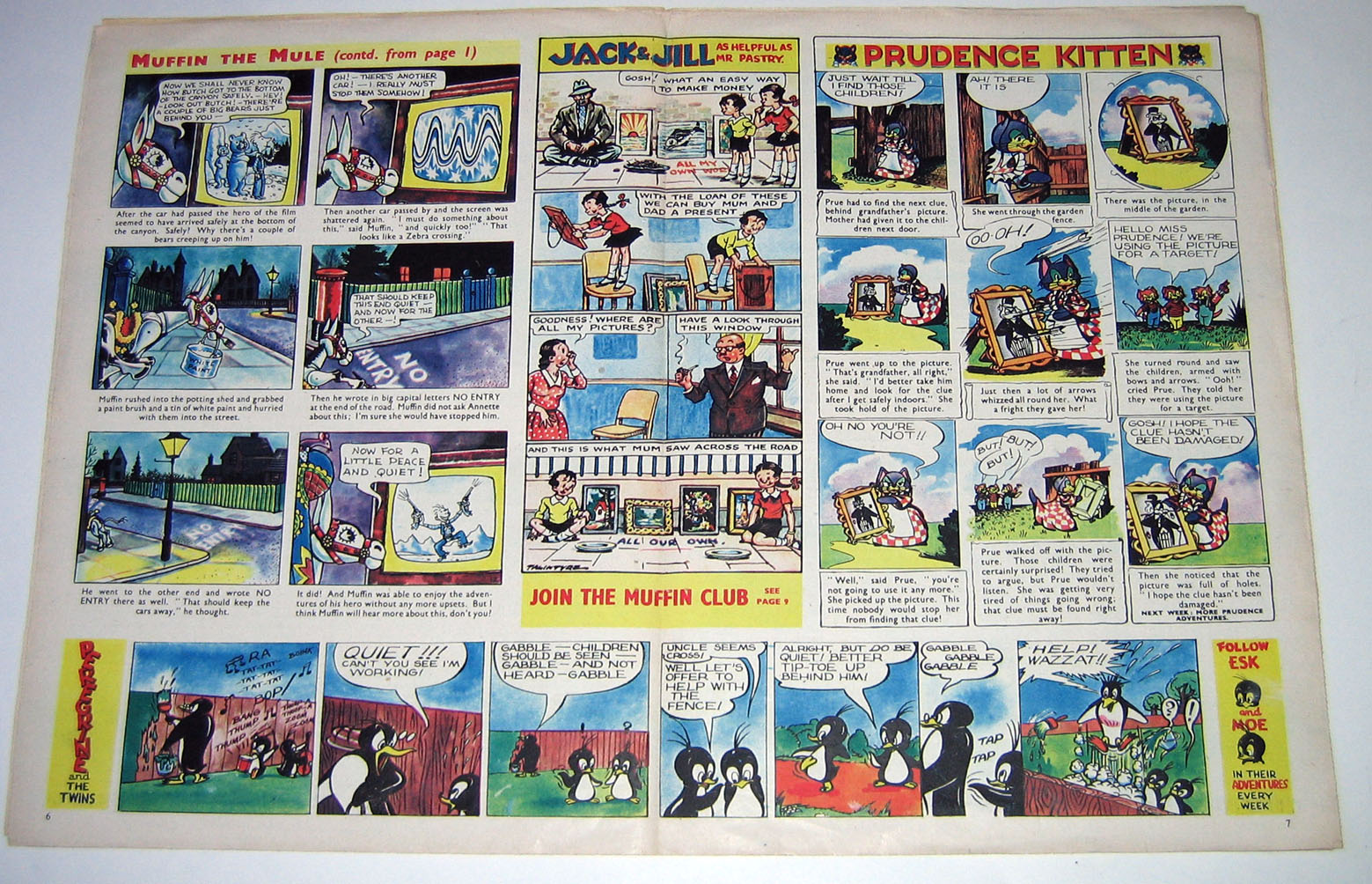
As you can see, the cover strip in 1952 was the hugely popular Muffin the Mule, based on the puppet that the nation's children had taken to their hearts. (These old comics offer a fantastic snapshot into history. Just look at that 1950s TV set!)
The artwork on Muffin the Mule was by Neville Main, who would become a regular on TV Comic, later illustrating the Hartnell Doctor Who strips and other features. The Muffin cover strip continued on the centre pages alongside strips by other artists.
 Mr.Pastry appeared on page 2 of TV Comic back then. (Pastry was a comedy performer, - real name Richard Hearne, - in case you were assuming he was a TV chef.) The artwork is by Lunt Roberts (according to Denis Gifford's Encyclopedia of Comic Characters), providing a nice bit of slapstick sequential art here.
 There were also text stories and articles in TV Comic back then, such as this activity feature. No snickering at the back there please...
 This Tusker & Tikki strip has some very nifty artwork by someone calling himself "Spike".
 With 8 pages of colour you'd have thought they'd have reserved one for Prince Valiant as they were reprinting the American Sunday pages. Sadly not, and Hal Foster's top quality work was reproduced in murky black and white instead, with an instruction for "young artists" to colour it themselves. (Luckily I managed to pluck this issue from the time vortex before any 1950s freckle-faced urchins with compulsory sticking-out ears had crayoned on it.)
 The Tom Puss strip opposite Prince Valiant is another reprint, this time of the Dutch strip Tom Poes by Marten Toonder. I assume this is a chapter of a longer story that was serializing one of the Tom Poes albums.
On the back page was Hank which, like Muffin the Mule, was also based on a puppet series. The lively artwork was by Ron Murdoch.
 For better or worse TV Comic underwent several changes over the years but this early issue shows what a quality product it was in its early stages. Even its logo was clearly designed and contemporary for its time, and the whole comic must have seemed very modern and exciting compared to most comics of the 1950s. Also, with television being in black and white back then imagine the impact the stunning colours of the TV Comic strips must have had on the readers.
A year later in 1953, Amalgamated Press launched a rival in the form of TV Fun, which had charms of its own but failed to last beyond 1959. In the meantime TV Comic continued its steady progress and managed an impressive run of 33 years, ending in 1984.

 What revenge will the cheeky villain known as Butt-Face take when the local council reject his plans for a Bum Museum? Find out in the latest issue of Toxic as Team Toxic once again get to the bottom of things.
 There are also three free gifts bagged in with the magazine, including an invisible ink pen. Toxic No.198. On sale now from newsagents, supermarkets, airports etc. 40 full colour pages for £2.75. http://www.toxicmag.co.uk/