NOTE: Blimey! is no longer being updated. Please visit http://lewstringercomics.blogspot.com for the latest updates about my comics work.
Showing posts with label Mick Anglo. Show all posts

Monday, December 29, 2014

Captain Universe No.1 (1954)

Independent comics proliferated in the UK in the years after World War 2. There were still restrictions on certain imports, including American comics (although some did filter through) so British publishers gained the rights to produce UK reprints of many US titles. They also created their own American-style comics, and numerous British superheroes began to appear. One of them was Captain Universe.

Captain Universe No.1 appeared in 1954 by The Arnold Book Company, a publisher based in London's Piccadilly. It was drawn (and perhaps created?) by Mick Anglo, who that same year had created Marvelman. There were similarities to Marvelman too, with Captain Universe's alter ego shouting a magic word to transform into the hero, and the character's seemingly infinite powers.

Here's the story to read for yourselves. It's a strange dreamlike tale with random occurrences and a cheery disregard for basic science. Captain Universe himself proves to be quite brutal, who ends up destroying an entire world! "It was a hard decision to make" he claims, even though we've just seen that it clearly wasn't. As for the 'Horror Plant' of the title, - it appears in just one panel and the Captain dismisses it with "G'wan! Lay off!". Some horror! 


Other stories in this 28 page comic feature Lt. Mike Miller of Homicide and a Western with Rocky Colt and Red Feather. Here are the opening pages...

There's also a one page True Space Facts page by Denis Gifford, who seemed to be in everything in those days!
One thing that Captain Universe didn't have in common with Marvelman was longevity. Issue 2 was the last. However, he did turn up decades later in a cameo appearance in The League of Extraordinary Gentlemen by Alan Moore and Kevin O'Neill, as seen here

You can read the story from Captain Universe No.2 in the book Great British Fantasy Comic Book Heroes, published by Ugly Duckling Press.

Saturday, December 27, 2014

Marvelman Annual 1960 (p.1959)

Marvelman was probably the UK's most popular superhero, as not only did he have a weekly comic in the 1950s to early 1960s he also had several hardback annuals. (As did his companion crime-fighter Young Marvelman.) I recently bought a copy of the Marvelman Annual that was published in 1959 and thought I'd show a few pages here.
This 96 page hardback was published by Len Miller and claims the illustrations are all by Mick Anglo, although that wasn't the case. I suspect that some of the strips are the early work of Don Lawrence, who drew a lot of the Marvelman strips back then.

The book has a good mixture of strips, text stories, puzzles, and a four page Flip and Flop humour strip by Denis Gifford...


There's also a Doc Holliday strip reprinted (and translated) from a European western comic. It's illustrated by the Spanish artrist José Gonzalez, who a few years later would produce fantastic work on the Vampirella comic.

It has to be said that the Marvelman stories were notably daft, and often contrived. Sometimes due to tight deadlines no doubt, but sometimes deliberately so. For example, in the 10 page story Pipe Dream, Marvelman's arch enemy Gargunza invents a method of time travel... using a bong pipe! 

It's hard to imagine the creators of the strip were innocent as to what bong pipes were used for, and Gargunza certainly goes on a 'trip'. Even more amusing is that when Marvelman discovers the pipe he wastes no time in trying it out himself! 

Anyway, here's the full story for your entertainment. Due to the printing limitations of the time, the strip switches from colour to black and white throughout, which is pretty trippy in itself. Don't do drugs, kids! 


The endpapers also highlight this story, with a crazed looking Gargunza inhaling from the pipe. I can't help wondering what, if any, reactions there were at the time. Just a few short years after that ridiculous outrage over horror comics, and there's a story with children's favourite Marvelman using a hookah pipe. However, I guess if it was okay for the caterpillar in Alice in Wonderland then it was considered okay for a Marvelman Annual. It still seems strange to modern eyes though, and I doubt any such scene would appear in an annual today.  


Tuesday, August 12, 2014

TV TORNADO (1967)

As with Solo (covered in the previous blog post) TV Tornado was a comic launched by City Magazines after the successes they'd had with TV Century 21 and Lady Penelope weeklies. Unfortunately it never reached the heights of popularity of those two comics, although it did manage to run for 88 weeks.

TV Tornado was a bit... odd. Take a look at the cover to issue 1 above for example. Various redrawn images of popular characters but the composition is quite bizarre, with Tarzan apparently threatening Batman and Robin much to the amusement of Hoss from Bonanza and the nonchalance of Superman. Even as a 7 year old I thought this was a strange cover, and I'm sure most readers would have preferred a more heroic illustration of Batman rather than the peculiarly cowering one that was used. 


Inside, the editorial by 'Ed Storm' tells us that TV Tornado is a "bumper bundle of thrills" featuring comic strips and text stories. It neglects to mention that The Phantom isn't actually a TV show, but perhaps he came as part of the King Features deal to use Flash Gordon. (Flash wasn't a TV series either at that stage but kids were familiar with him due to the 1930s chapter serials still being screened at Saturday morning matinees at ABC cinemas.) 


Everything about TV Tornado screamed low budget, from its one colour page (the front cover) to its use of prose stories and U.S. newspaper strips. It does have some interest for collectors though. Here's a three page Batman text story from issue 1...


There were also text stories for The Man from UNCLE and Superman...


Curiously, Batman and Superman were only in the first few issues. The next issue I have is issue 10, by which time they'd been replaced by The Green Hornet and Magnus, Robot Fighter. The latter was a popular American comic published by Gold Key but the strip in TV Tornado appears to be new.

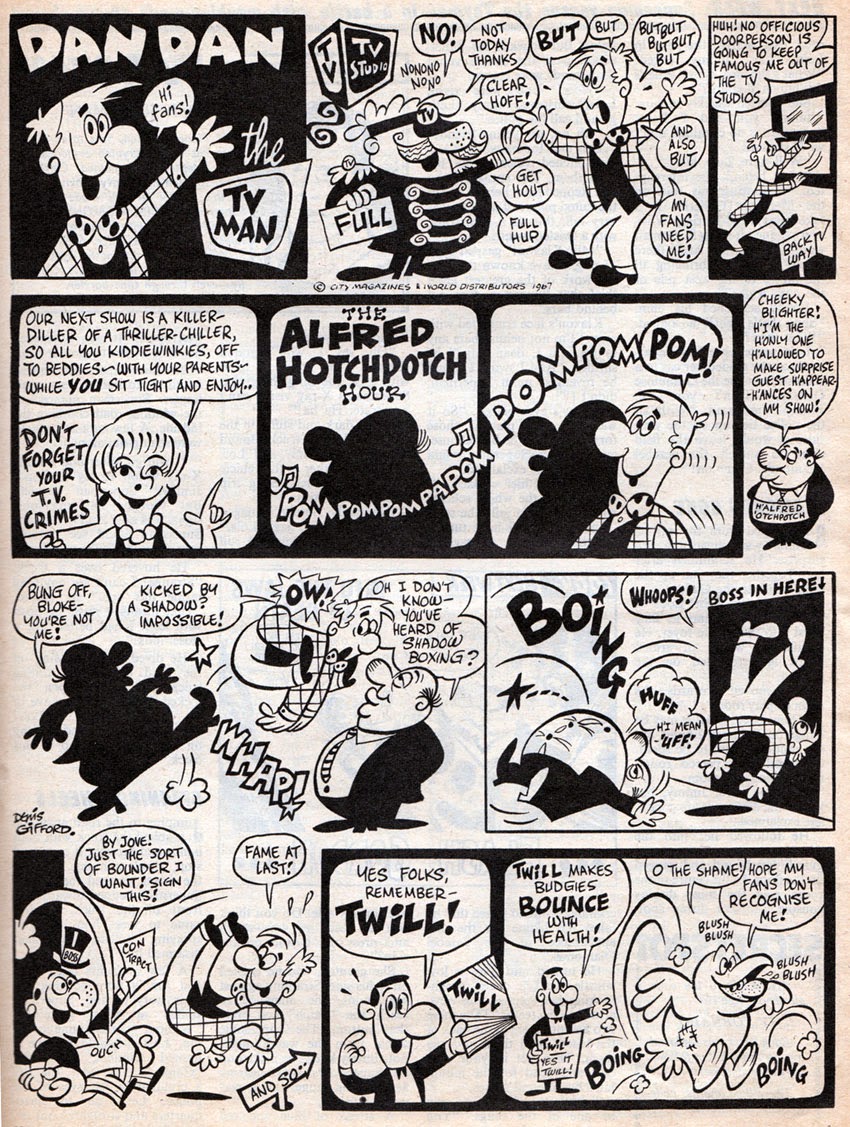
TV Tornado also carried a new humour strip, - Dan Dan the TV Man by Denis Gifford...

With issue 37, the comic became TV Tornado and Solo, absorbing its ill-fated companion comic.

By this time, The Saint was starring in the comic, based on the hugely popular Roger Moore TV show.


A new addition to the merged title was The Mysterons, in order to cash in on the Captain Scarlet and The Mysterons TV series which debuted on ITV that week. The first episode of this strip had appeared in the final issue of Solo the week before (see my previous post). Despite being drawn by Don Harley, one of the top artists of the day, The Mysterons was a strange concept for a strip. In the TV series, we only see the Mysterons as copies of the humans or vehicles they've destroyed, created by twin circular beams of light. The comic strip took the imagery literally, initially showing the Mysterons as beings of hooped light, then changing them into physical hexagonal beings! The idea behind the stories seems to be to emulate the style of The Daleks strip from TV21, but it really struggles to work and I can't imagine many readers really connecting with it. 


The editor of TV Tornado was someone who'll be very familiar to many; Mick Anglo, creator of Marvelman. He also illustrated some of the material for TV Tornado, including the Voyage to the Bottom of the Sea strip and some covers I believe. 

TV Tornado lasted for 88 issues, and merged into TV21 in September 1968.  

Friday, November 11, 2011

Mick Anglo 1916 - 2011


Mick Anglo, creator of Marvelman, passed away on October 31st at the age of 95.

Although Marvelman was easily the character he was most associated with, Mick Anglo's career in publishing saw him enjoy a variety of accomplishments. He freelanced in commercial art when he left school, drew cartoons for overseas army newspapers during the war, and then became an author of western, romance and crime novels under the name Johnny Dekker as well as continuing to draw for various publishers.


Between 1950 to 1952 Anglo produced various comic strips for the Arnold Book Company (run by Arnold Miller) and for Arnold's father's company L.Miller & Son. In 1954 Anglo opened his own company, Gower Studios, to package comics for various publishers (ie: produce full comics to the specifications of a publisher, ready for printing). Mick Anglo's staff included Ron Embleton, Bob Monkhouse, and Denis Gifford. He also gave Don Lawrence his first break, years before Lawrence would go on to produce the stunning Trigan Empire series.


When legal problems between Fawcett Publications and National Comics (now DC Comics) forced Fawcett's Captain Marvel comics to close, Mick Anglo created Marvelman to fill the gap for the Captain Marvel UK reprints, with Anglo and his studio producing brand new stories. The similarities between Captain Marvel and Marvelman were plain to see, but readers eagerly took to the character (and its spin-offs Marvelman Family and Young Marvelman) and the comics continued into the early 1960s. Bearing in mind those comics were weekly, Anglo's output was considerable. Even today, Marvelman remains the most successful British superhero in terms of how many issues were produced (346 issues, plus the same number of Young Marvelman comics, and 30 issues of Marvelman Family).


Mick Anglo continued to produce more comics in the 1960s, including, amongst other things, becoming editor of City Magazines' TV Tornado in 1967, and Super DC for Top Sellers in 1970. He retired in the 1980s.


In 1982 Dez Skinn revived Marvelman (with Alan Moore as writer and Garry Leach as artist) for the new monthly anthology comic Warrior. Here things became darker, not only in the tone of story but also in reality, with Marvel Comics threatening legal action over the name of the character, with Marvelman becoming Miracleman for the American editions published by Eclipse Comics. The story of further developments is a saga in itself, but in 2009 Mick Anglo sold the rights of Marvelman to Marvel Comics. Since then, Marvel have produced a mini-series of reprints (Marvelman Family's Finest) and a few hardback reprints. No new Marvelman series has yet been announced.


For a feature on Super DC see here:
http://lewstringer.blogspot.com/2007/03/super-dc.html
Related Posts Plugin for WordPress, Blogger...