Puck ran from 1904 to May 1940, so this 1939 issue was its final Christmas edition. Published by Amalgamated Press, Puck was an 8 page tabloid, although this festive issue has 12 pages.
I'm not 100% sure who the cover artist is. My feeling is that it's Roy Wilson, but he had so many imitators, due to editors telling other artists to "ghost" him, it could be John Jukes or someone else entirely! I'm betting it's Wilson though.
Inside, Rob the Rover was a popular strip of the time, drawn by Walter Booth.
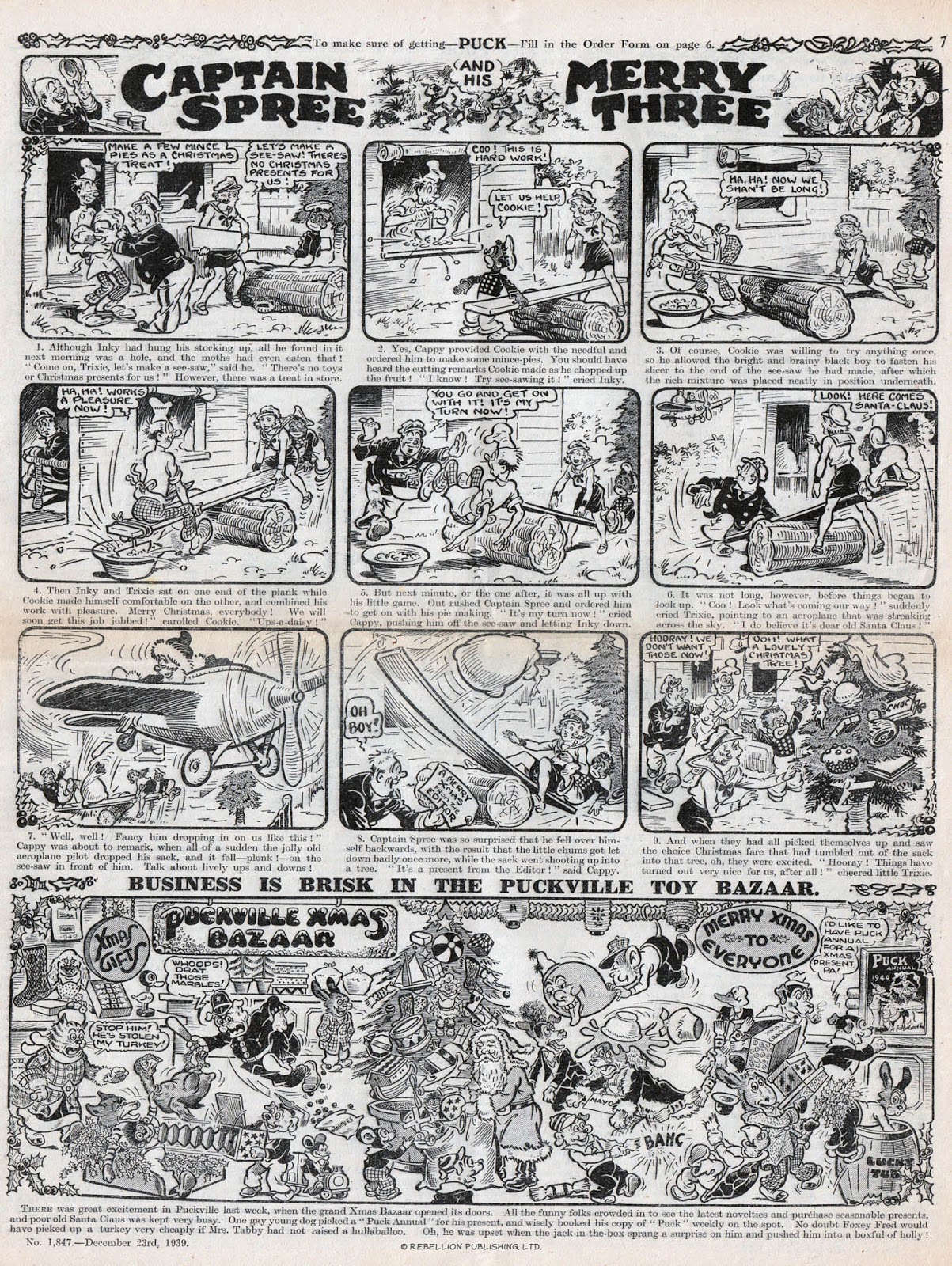
Captain Spree and his Merry Three is typical of the times, in a bad way, in that it includes a racist caricature character, "Inky". His appearance becomes even more noticeable because Trixie is drawn almost realistically. One positive point is we're told that Inky is a "bright and brainy black boy", which I suppose makes a change from black characters being depicted as dim and slow-witted as shown in other strips.
My research informs me that the Puckville strip at the bottom of that page is by Bert Hill.
Like other comics of the period, Puck contained a balance of strips and prose stories. One of the latter featured Rin-Tin-Tin the famous canine star of the movies...
On the back page, - Dick Drew, the Hunted Cowboy - Fighting for his Own! I don'y know who drew it, but it's highly competent artwork and has seasonal references so I'm including it here.
One of the great injustices of British comics history is that for decades most artists were not allowed to sign their work. Writers also went uncredited. I try to identify strips if I can (and others inform me too) but it really is a disgrace that so many brilliant creators are forgotten now, for no good reason whatsoever.
Another Christmas comic tomorrow, so please join us again!
Here's a comic that the kids of 1916 were reading, exactly 100 years ago this week. Sparks was published by James Henderson and Sons Ltd. and ran from 1914 to 1917. Like most comics of the time, it consisted of 8 tabloid pages, although by the time this issue appeared the format had become shorter, almost square in shape.
The cover strip, clearly inspired by Chips' Weary Willie and Tired Tim, was The Funny Adventures of Lemon and Dash. Like Willie and Tim, they were two wandering tramps getting into amusing situations every issue. The artwork was by Louis Briault (1885 to 1944), who also drew for comics such as The Funny Wonder, Comic Cuts, and Comic Life.
Like most comics of the day, Sparks carried a 50/50 split of prose stories and comic strips. The centre pages featured numerous short strips and gag cartoons crammed across the spread. Here are just some of them. as always, click on the pages to enlarge them.
One of the text stories, The Arch Rogue, featured Superman's catchphrase over 20 years before the Man of Steel even appeared. Up, up, and away!
On the back page, another mixture of strips and cartoons. Daniel Dauber was drawn by Walter Booth, who had a long career in comics throughout the first half of the 20th Century. I'm afraid I don't know the identities of the other artists, who are sadly all anonymous.
A bumper post today with no less than three Amalgamated Press comics from my collection that were all on sale this week in 1937! I've a lot to cover so I'll try to keep it brief.
Let's begin with Puck No.1,717 and an excellent cover (above) by Roy Wilson to illustrate Don and Doris. The strip had begun a year earlier as Don the Day-dreamer
about a boy who dreams of having great adventures, but by 1937 the
everyday realities of ordinary but amusing antics had taken over...
Long before Black Bob amazed us,
was the real life canine superstar Rin-Tin-Tin whose life was later fictionalised in radio, films and in the pages of Puck.
Compared to the other two comics showcased today, Puck
was the old-timer, having been around since 1904. The contents of this
12 page issue were mainly adventure based, with exciting serials such as
Captain Moonlight. The three panels showing the decent of the
windmill sails not only break away from the traditional layout but
feature artwork that is more sequential than most UK adventure strips of
the period. Artwork by Walter Booth.

Booth was also the artist on Rob the Rover,
Britain's first adventure strip. This particular strip is quite eerie
because it features the fiery fate of an airship just six weeks after
the real-life tragedy of the Hindenburg disaster!
Dozens of airships had exploded over the years (including the British
R-101 with the loss of 48 lives in 1930) but the proximity of this strip
to the Hindenburg tragedy seems a little too close for comfort. The
schedules of publishing comics back then usually meant that strips were
drawn six to eight weeks ahead of publication so this was presumably bad
timing rather than bad taste.
Moving onto The Joker No.504, there's a wonderfully illustrated masthead (by who, I do not know) above a lively Alfie the Air Tramp strip by John Jukes I think.
Inside, Buck Tupp and Flannelfoot draw comedy from the then-popular craze for cowboys and Indians.
Bright and Gay was a feature based on the sort of comedy patter seen in variety hall double acts of the time...
On page 6 of that issue, an ad for Jolly Comic, which at the time had the UK license to publish Popeye by Elzie Segar (as seen in a previous post)...
The back page of Joker brought us the serial Chang The Yellow Pirate (the sort of racist description that's quite rightly embarrassing these days). Art by Colin Merritt.
Finally, here's Crackers No.436. This comic was 2d for 12 pages and ran from 1929 to 1941. The cover strip features The Adventures of Bob and Betty Britten, drawn by Alex Akerbladh. According to Denis Gifford's Encyclopedia of British Comic Characters this was the first full colour British adventure strip!
Inside, there was a busy mixture of more adventure strips, text stories, features, and a couple of humour strips.
One of the humour strips was Happy Harry and Sister Sue by the great Roy Wilson (whose style influenced so many artists of the day). Beneath it, a feature that would inflame sensibilities today. Editors nowadays would have a fit at the notion of encouraging children to be interested in such items, yet even up to the 1960s activity pages such as Mr.Knowall in Smash! would show kids how to play tricks with matches.
On the back page, Terry and Trixie, The Stars of the Circus. Like the cover, this was also drawn by the Swedish born Alex Akerbladh. You may have noticed that several few strips I've shown today feature a boy and a girl in equal billing. An early indication of equal rights in comics perhaps?
Below is a photo of how part of a
newsagent's counter display may have looked this day 75 years ago, back
in the times when comics were beside the till, making them look smarter and more attractive to customers instead of being rammed into
shelves as they are today.