NOTE: Blimey! is no longer being updated. Please visit http://lewstringercomics.blogspot.com for the latest updates about my comics work.
Showing posts with label Alex Akerbladh. Show all posts

Saturday, February 04, 2017

100 Year Flashback: MERRY AND BRIGHT (1917)

Merry and Bright was a weekly comic published by The Amalgamated Press from 1910 to 1935. It was printed with black ink on green paper, and, like most A.P. comics, had just 8 tabloid sized pages. 

I bought this issue from 1917 recently, in fantastic condition proving, as I've always said, that if comics are looked after they won't fall apart after a few decades. 

The cover strip features Phil Ray, a music-hall comedian of the time. Decades before Look-In, it was a trend to feature celebrities in strip form. (A.P. would emphasise this even more when they launched Film Fun three years later in 1920.) Artwork by Swedish-born cartoonist Alex Akerbladh. 

As you may have noticed from the cover topline, Merry and Bright was about to absorb The Favourite Comic. Page two went into more detail in an editorial tucked away in the corner. (As always, click on the pages to see them full size.)

It's refreshing how honest the editorial is about the reasons for the merger. Here's a larger version to save you straining your eyes...

Merry and Bright had the usual equal division of strip pages and prose story pages. Here's another page of strips. Corny Cachou is by Bertie Brown. 

On the back page was Curly Kelly, drawn by G.M. Payne. I suspect that Curly may have been another real-life comedian of the day considering the strip uses a signature like the cover strip. Any info welcome.

I hope you've enjoyed this look back at what kids were reading a century ago. Please post your comments below if you're inclined. 

Wednesday, February 04, 2015

T.V. Fun No.1 (1953)

T.V. Fun No.1. Cover date: September 19th 1953. 
Price: 3d (1p). Every Monday (but probably out the previous Saturday.)
Publisher: The Amalgamated Press Ltd.
Page count: 20, comprising of four full colour, four spot colour (red), 12 black and white.
Page size: 24cm wide by 32cm high. 
Print quality: newsprint.

The year 1953 was a turning point for The Amalgamated Press. In one fell swoop they axed their three longest running comics. Comic Cuts, Illustrated Chips, and Wonder (formerly The Funny Wonder) were all cancelled in the same week, and replaced the following week with a brand new comic, TV Fun.

Clearly A.P. were determined to appear up-to-date by jettisoning their oldest comics in favour of one that reflected the new television age. Comic Cuts and Chips had run for over 60 years. Would TV Fun prove to be a worthy successor? Sadly not. It survived for just six years, changing its title to TV Fan for its last few months and merging into the romance comic Valentine in 1960.

Truth be told though, TV Fun wasn't a bad comic by any means. It was perhaps just not as modern-looking as A.P. would have hoped, despite its full colour covers (which the extinguished comics had lacked). To its credit it did feature work by some of the top artists in British comics, so let's look at a few pages from issue one. 

On the cover (above), the Arthur Askey strip had sort of made the jump from A.P.'s Radio Fun to herald this new venture. The artwork is by Arthur Martin.

Turning the page, the first thing the reader would be confronted with was a two page text story As Midnight Chimes. Prose stories like these were still a common feature of comics of the 1950s. 
Panel shows have always been a staple part of the TV schedules (because they're relatively cheap to do) and TV Fun reflected that with Put Your Question. I thought this was the work of Cyril Price but I'm reliably informed by comic historian Ray Moore that it's by Alex Akerbladh, and the last series he drew for A.P.
TV Fun contained a good balance of humour strips, prose stories, and adventure strips. One of the latter being Call In The Yard...
No less than five prose stories appeared in the comic. One of them was a complete story featuring super-spy Valda...
An adventure strip was awarded the full colour centre pages, with chapter one of The House With Red Shutters illustrated by George Heath...

The excellent Roy Wilson had a place in the new comic too, with two strips on page 14: Who's Who in Our Zoo, and Hoofer the Tee Vee Gee Gee. Neither of which were actually TV characters but TV Fun seemed to be aiming for the essence of a TV show in some of its strips, rather than filling it with adaptations. 
However, a TV celebrity did appear on the facing page in the form of Jimmy Edwards. Artwork by Reg Parlett, packing a lot into the page...
Despite this being a new comic and the company's big new launch, the editorial didn't appear until the inside back page, tucked away at the bottom. There the editor welcomed the readers, told them of things to come, and recounted his week. Which is all well and good until he cracks a racist joke. 
On the back page, a full colour strip starring Diana Decker 'The Cutie Queen of the TV Screen'. Judging from the times Ms.Decker flashes her legs in this and subsequent strips I think it's fair to say that A.P. were aiming TV Fun at an older reader than Thomson's Dandy and Beano. It looks to me that Bertie Brown was the artist of this page, and well chosen too for his ability to draw the female figure. 
Surprisingly (to me at any rate) I won this first issue on eBay last week for just £9.99. Either not many people noticed it or interest in pre-1960s British comics is waning fast. Of course, many collectors buy for nostalgia, and anyone who had this comic as a child would be in their late sixties by now and most likely to be cutting back on their collection rather than building it up. I hope showing a few pages from it here have been of interest to readers of this blog anyway. 

As always, click on each page to see it at a larger and more legible size.

Thursday, February 13, 2014

Radio Fun's first revamp


Comics often have various revamps and new looks over their long runs, and Radio Fun was certainly no exception. Yet it's first revamp came just a few weeks into its 23 year run. 

When Radio Fun was launched in 1938 its cover star was George the Jolly Gee-Gee, drawn by Amalgamated Press' top humourist Roy Wilson. Presumably George was on the cover because Radio Fun's rivals Dandy and Beano had animal characters on their covers. However, it seems editor Stanley Gooch soon had misgivings about this, thinking that a comic called Radio Fun ought to have something connected with radio on the front page. 

Therefore, with issue 18, dated February 11th 1939, Radio Fun had a mini-revamp, with a new logo, a free gift, and a new cover star, - Big Hearted Arthur, drawn by Reg Parlett. The character was of course Arthur Askey, who had previously had a strip inside the comic, but Arthur was very popular in 1939 and deserved his cover slot.

Inside the 28 page comic, the set-up had a few tweaks. George the Jolly Gee-Gee was relegated to a black and white half pager. I'm not even sure if this one was drawn by Roy Wilson as it's not up to his usual standard, but perhaps the sudden switch to a different format had required it to be drawn quickly.


Flanagan and Allen, previously in black and white, was now promoted to the centre pages and given a splash of red spot colour. The artwork was by Alex Akerbladh. Bud Flanagan and Chesney Allen's success on the stage, screen, and radio would continue throughout the war years, so they were ideal stars for Radio Fun. Here's a Pathé newsreel clip of them from 1941:
http://www.britishpathe.com/video/flanagan-and-allen-underneath-the-arches


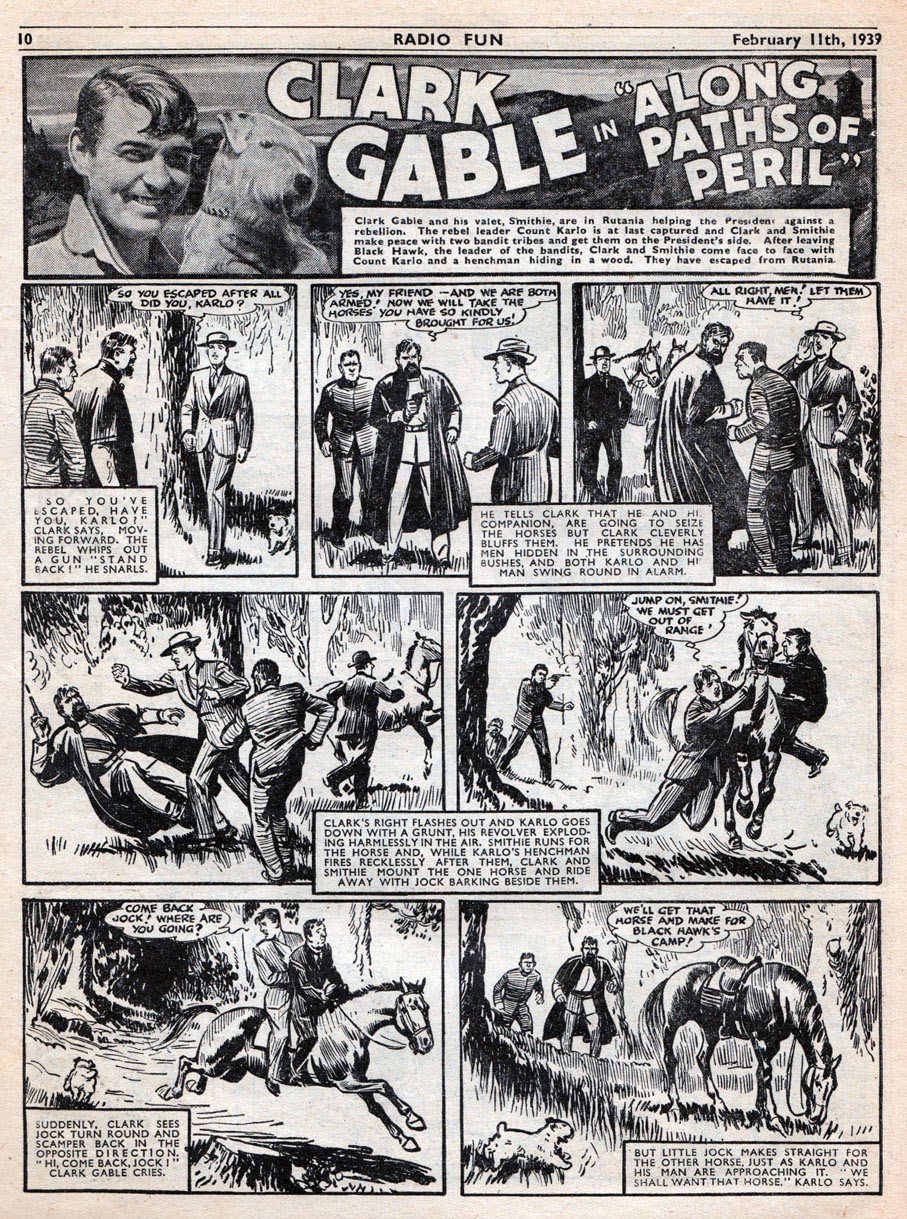
The rest of the comic carried on unchanged, with its mixture of prose stories and comic strips. Despite its title, Radio Fun never limited itself solely to radio stars. Here's Clark Gable in the latest installment of Along Paths of Peril drawn by George Heath.


Another big UK star of the time was Sandy Powell. Like many performers of the time he'd begun his career in the music halls. By the 1930s his radio career was underway, and his catchphrase "Can you hear me, mother?" became famous across the land. (Some people still use it today!) The comic strip in Radio Fun was drawn by George Parlett, brother of cover artist Reg.


George Parlett also illustrated the two page Radio Fun Music Hall serial. I know I've shown one of these on this blog before but it's such a great strip it's worth showing another. The layout of the pages, mixing art and rhyme, are quite unique and ahead of their time. 


I mentioned that this issue contained a free gift. Here it is, - the Radio Fun Bumper Song Book; a 28 page giveaway featuring the sheet music to "20 latest hits" such as London is Saying Good Night, I'm Knitting a Singlet for Cecil, and When Granny Wore Her Crinoline


Those songs are mostly lost to the mists of time by now, but here's a couple if you're curious...


There was also a free gift scheduled for the following week in the form of 'Magic Spectacles' and 'Living Pictures' that "spring to life before your eyes". I'm assuming they were an early form of 3-D specs. 


Radio Fun was a worthy rival to DC Thomson's comics. I have a good selection of issues from over the years and I think if I'd been around back then it would definitely have been one comic I'd have plonked down my 2d every week for. 

(As always, click on each page to see it larger. You may then need to click again to see it even bigger.)

Friday, October 26, 2012

This week in 1938: RADIO FUN No.3

 
You've seen samples of Radio Fun on this blog from the 1940s and 1950s but here's a few pages from No.3, the earliest edition in my collection, which was on sale exactly 74 years ago this week, in October 1938.

In these early issues, Radio Fun had a bright full colour cover. Sadly WW2 put paid to that and printing limitations confined it to red spot colour for the rest of its long run. Here though is an eye-catching full colour cover where publishers Amalgamated Press are clearly trying to emulate the style of their rival comics Dandy and Beano. Like their rivals, Radio Fun even had an animal star on the cover, even though it had nothing to do with radio! However, despite lovely artwork by Roy Wilson, George the Jolly Gee-Gee was no Korky the Cat. By issue 18 (seen here) the nag was relegated inside the comic, whilst Big Hearted Arthur (Askey) was promoted to a more fitting position on the cover. 

Like its DC Thomson rivals, Radio Fun had 28 pages in this pre-war era. The contents were evenly divided between comic strip and prose stories. Variety act Flanagan and Allen were the stars of the first strip inside the comic. Artwork by veteran illustrator Alex Akerbladh, a Swedish born artist who had been working for AP comics since 1909. 


That master of comic strip slapstick Reg Parlett was on top form drawing Revnell and West, featuring two standards of classic British comics; scrumping and spanking. 


Whilst it was obviously a bit of fun for the comic to show comedy performers getting involved in scrapes, it seemed more surreal when the same practice was employed for the adventure strips. Here's the actor Clark Gable portrayed as having a lifestyle of deadly danger and intrigue. Artwork by George Heath...


The centre pages of this issue featured a fantastic strip drawn by George Parlett. Radio Fun Music Hall broke out of the conventions of traditional framed panels, preferring to use a fluid mixture of artwork and hand-lettered text. Notice how tight the blouse is on Sweet Nell (or "a nice bit of stuff" as she's called here). Clearly, Radio Fun was aimed at kids and their dads!


On the back page, Big-Hearted Arthur, another Reg Parlett strip. As I mentioned earlier, this would become the cover strip for a while from issue 18. 


I hope you've enjoyed this brief time-trip to 1938. Click on the images to see them much larger, and you may need to click again to see them larger still.

Where, or when, will we visit next? I've no idea! Find out soon!
Related Posts Plugin for WordPress, Blogger...