NOTE: Blimey! is no longer being updated. Please visit http://lewstringercomics.blogspot.com for the latest updates about my comics work.
Showing posts sorted by relevance for query Spider-Man Comics Weekly. Sort by date Show all posts

Tuesday, March 13, 2007

Marvel UK: The early years


Reprints of US Marvel Comics for the British market had met with limited success prior to the 1970s. The 1950s had seen UK black and white versions of Human Torch and Captain America, the sixties had the Odhams "Power Comics" such as Fantastic (as well as the Alan Class titles such as Creepy Worlds) and even the latter issues of TV21 in 1971 had featured edited reprints of Silver Surfer, Spider-Man, Ringo Kid and the Western Ghost Rider.

After IPC published two annuals of Marvel reprints in 1971 and 1972 (called simply Marvel Annual) there was speculation that the company was about to launch a weekly. Whether this was true or not it never came to pass, as Marvel US was about to take charge of its own destiny where their British readers were concerned.

On Saturday September 30th 1972, the first issue of The Mighty World of Marvel took readers by surprise, heralding the start of Marvel's UK operation. (Even though, in those early days, the comics were actually edited in the USA by Tony Isabella but printed in England.) This 40 page first issue had real impact, kicking off with a cover by John Buscema and contents starting with the origin stories of The Hulk, The Fantastic Four, and Spider-Man its intention was clear, - forget the Marvel reprints of the past which were handled by others, this was a new beginning from day one with Marvel firmly in the driver's seat. To accentuate its authenticity it even contained an editorial from Stan Lee.

The comic only had four pages in full colour. The rest used spot colour (green, mainly for the benefit of the Hulk strip). It would be several years before full colour was used throughout Marvel UK comics. (By which time the original MWOM would be gone.)

Previous British comics featuring Marvel material had always used reprinted covers from US comics, but MWOM had the luxury of brand new covers, many, from issue two's powerful Hulk cover, were by a young Jim Starlin, who was also wowing his readers in the USA with his work on Captain Marvel. (Some of Starlin's covers for Mighty World of Marvel can be seen above.)

With the success of Mighty World of Marvel, Marvel UK launched their second weekly on February 10th 1973. Spinning out of the pages of MWOM , Spider-Man became the star of Spider-Man Comics Weekly, which introduced Thor as a back up strip. The first issue was also used to promote Marvel's new fan club F.O.O.M. (Friends Of Ol' Marvel) with a 50p subscription form. It was now clear that Marvel saw the UK as a lucrative base to recruit new readers.

The emphasis wasn't all American though. Keeping up the British tradition of free gifts in first issues of new comics, MWOM had given away an impressive iron-on transfer of the Hulk. Spider-Man Comics Weekly promised a Spider-Man Mask! Excitement was short lived though when the "mask" turned out to be... a paper bag, which when worn looked more like a Klan hood (see photo).

Daredevil filled the space left by Spider-Man in the pages of Mighty World of Marvel, as the plan to gradually introduce more characters to UK readers took shape. The fact that all of these strips had previously been seen in the Odhams comics only a few years earlier apparently made little difference to the sales of the two new weeklies. Why were MWOM and Spider-Man Comics Weekly succeeding where previous Marvel reprints had failed? Perhaps because readers knew these were "proper" Marvel comics? Perhaps because they had lively attractive covers? Or possibly because the time gap between origination and reprint was wider now and these weeklies were the only opportunity of obtaining the early Marvel material.

September 15th 1973 saw the third Marvel UK weekly appear. Simply titled The Avengers its format was slightly different to its sister papers. Unlike MWOM and Spidey it had glossy covers, although this was at the cost of having no interior colour pages. (Although by this time the other two comics were also losing their spot colour interiors.) The back up strip for The Avengers was Doctor Strange, whilst over in Spider-Man Comics Weekly the 20 page Spidey stories were about to be halved to accommodate reprints of Iron Man.

Soon, Mighty World of Marvel and Spider-Man Comics Weekly both adopted the same format as The Avengers: 36 pages including colour glossy covers. They would soon be joined by an onslaught of companion titles; Dracula Lives!, Planet of the Apes, The Superheroes, Savage Sword of Conan and many more. Some would fail (Conan lasted just 18 weeks) whilst others would triumph (Spider-Man underwent many title changes and restarts and still survives today in the form of The Astonishing Spider-Man).

The Mighty World of Marvel had a long run, swallowing up various flailing weeklies from diverse titles as Planet of the Apes to Fury. Eventually, its own dwindling sales required it to have a revamp and new editor Dez Skinn simplified its title to Marvel. Perhaps the changes came too late, and it folded, but was reborn as The Mighty World of Marvel volume two, a monthly, in the early 1980s. Sadly, that failed, but the title was revived again a few years ago and The Mighty World of Marvel volume 3 (now published by Panini, who handle all Marvel's UK output) has been successful. The impressive 76 page full-colour monthly is now up to its 53rd issue. Together with its group of companion comics, from Avengers United to the newest title Marvel Legends, it would appear that Marvel are once again firmly established in the UK.

To find out more about current UK Marvel editions visit the Panini UK website:
http://www.paninicomics.co.uk/Home.jsp


Thursday, March 15, 2018

Out now from Panini UK


The very first UK Spider-Man title was Spider-Man Comics Weekly, launched in 1973. Although he'd previously appeared in Pow!, Smash!, TV21, and The Mighty World of Marvel, (and various Alan Class comics) Spider-Man Comics Weekly was the first British comic named after the character.

That title went through various changes; Super Spider-Man, Spider-Man TV Comic, Spidey, and others.. and led to other Marvel UK comics such as The Exploits of Spider-Man. The current one, The Astonishing Spider-Man, has been running since 1995, and has been the most consistent. Apparently it's the most popular of Panini's Marvel Collectors Editions as it's the only one published fortnightly instead of every four weeks. It's had various re-numberings, and the current issue is Volume 6, No.42 which goes on sale today.

Astonishing Spider-Man Vol.6 #42. On sale 15th March! 
76 pages packed with arachnid-adventure! Only £3.99!

Peter Parker is on the run and hunted by the NYPD! (So, business as usual.)
Also: How did Normie Osborn become the CEO of Oscorp, and what does he have planned for Spider-Man?!!
Plus: The Wall-Crawler vs. The Sleeper! ‘Nuff said!
By Chip Zdarsky, Adam Kubert, Juan Frigeri, Ryan Stegman, Nathan Stockman, Mark Waid, James Robinson and Gabrielle Dell’Otto.
Includes material reprinted from Peter Parker, The Spectacular Spider-Man #297, Amazing Spider-Man: Renew Your Vows #10 and Amazing Spider-Man: Family Business: Original Graphic Novel.


There's also a monthly Spider-Man magazine for younger readers that features some comic strip material. This has also gone through a few title changes and for several years it featured all-new Spider-Man strips by British creators. Sadly, it now features American material.

Cover image of the junior Spider-Man comic from this site:
http://www.newsstand.co.uk/108-Primary-Boys-Magazines/3297-Subscribe-to-SPIDERMAN-MAGAZINE-Magazine-Subscription.aspx


Sunday, January 11, 2015

Panini UK relaunch Astonishing Spider-Man

Panini UK's fortnightly comic The Astonishing Spider-Man gets another relaunch with a new No.1 this Thursday, 15th January.

The comic's previous run ends with issue 33 (on sale now) which concludes the 'Superior Spider-Man' story arc of Doctor Octopus inhabiting the mind of Peter Parker. A controversial story, but one which I really liked. Personally I've never been a huge fan of Spider-Man comics. I liked Steve Ditko's run in the sixties, and the issues that John Romita inked himself in 1972, but otherwise I've been fairly indifferent to the strips. (Although I've still followed it on and off over the decades.) However, since Dan Slott took over the writing duties several years ago he's really turned the Spider-Man strip around, providing good solid escapist fun and various twists and turns. Having Doc Ock as an arrogant Spider-Man provided a lot of laughs. 

With the new Astonishing Spider-Man No.1, Peter Parker has regained control of his own mind and body and the status quo is restored. And in Parker's life that means various ups and downs, including dealing with people who Doc Ock had cheesed off (as most people didn't know Parker had been 'taken over').

Along with other material, The Astonishing Spider-Man No.1 reprints the American Marvel comic The Amazing Spider-Man No.1 from June 2014, which was the top selling comic of the year (see news item on Down The Tubes). Story by Dan Slott, artwork by Humberto Ramos. 
This is the fifth renumbering of The Astonishing Spider-Man, a comic which dates back to 1995. Prior to that, Marvel UK had been publishing Spider-Man under various titles since Spider-Man Comics Weekly in 1973. And before that, reprints of Spider-Man's early adventures had appeared in Pow! (1967/68), Smash! and Pow! (1968) and TV21 (1970/71). Selected Spider-Man reprints also appeared randomly in various Alan Class comics in the 1960s. 

The Astonishing Spider-Man No.1, on sale 15th January from WH Smiths and other shops. 100 pages for £3.50. 

Friday, March 02, 2012

Marvel UK: Captain Wally and Snail-Man

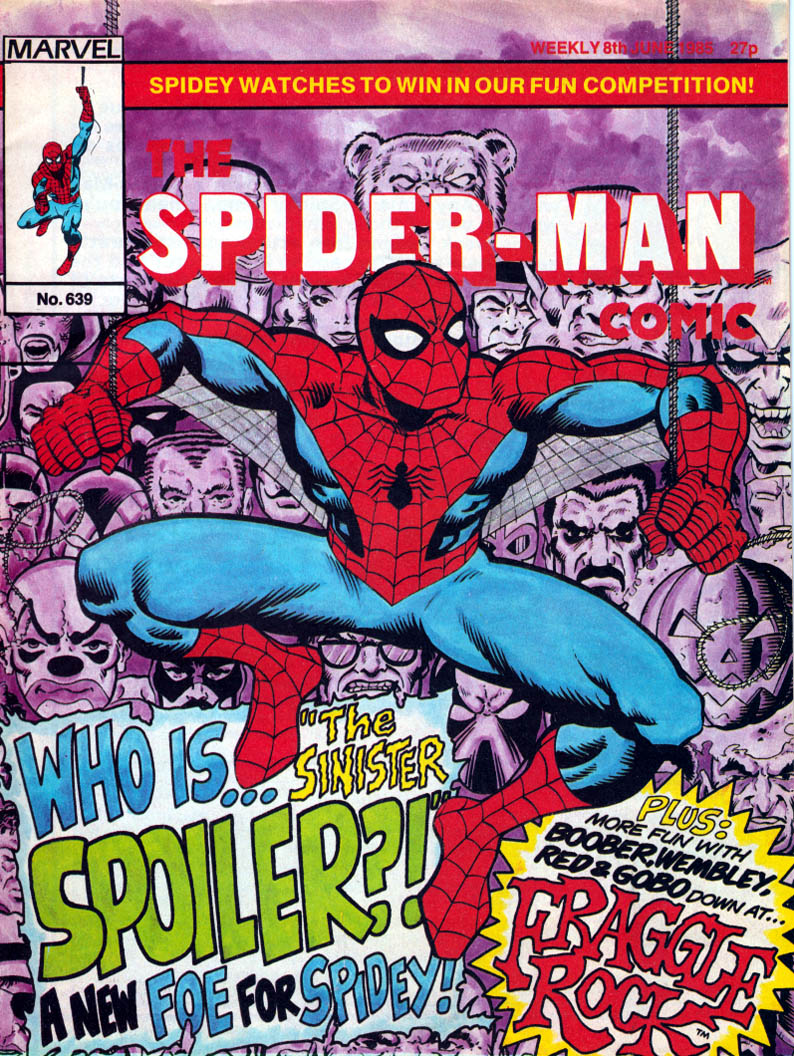
Back in 1985 sales of the British Spider-Man weekly were in need of a boost. The solution, Marvel UK decided, was to pitch it at a younger readership as sales of other comics were strong in that area.

The result was The Spider-Man Comic, a 32 page weekly with half its pages in full colour, featuring reprints of Spider-Man stories from Spidey Super Stories, an early-learner comic that Marvel US had been publishing. Other reprints included Fraggle Rock and Willy the Wizard (which had been called Wally the Wizard in the USA, but Marvel UK changed it to 'Willy' avoid unexpected laughter. Yes, quite.) Reprints of The Dukes of Hazard from TV Comic also started running a few weeks later.

The editor was Sheila Cranna, whom I'd worked for on my very first regular strip, Robo-Capers, for Transformers. Sheila asked me to come up with some ideas for the comic's revamp and I submitted two superhero-spoof characters, Captain Wally and Snail-Man. Happily Sheila liked both and I was commissioned to produce a full page Captain Wally every week along with a half page Snail-Man.

Here's the first Captain Wally...


...and the first Snail-Man...


As you can see, both characters were set in a very English suburban environment. This formula had worked well for children's comics for years, usually with Dennis the Menace style strips, so I thought it'd make superheroes look even more ludicrous than they are by placing them in that setting. Adding to that, neither characters had any independence in their lives. Wally lived with his parents whilst Snail-Man lived with his brutally domineering Aunt Maim, thus further emasculating the concept of the strong super-hero.


With the third Captain Wally strip I had Cap meet the Hulk. As far as I was concerned, this titanic meeting of Captain Wally and The Incredible Hulk is firmly set in continuity... even though I'm sure Marvel never saw it that way.


Sheila Cranna was a pleasure to work for and I thoroughly enjoyed producing these strips every week. I was still fairly new to the business and certainly learning the ropes (some of the artwork here is a considerably rough and wonky) but I was very pleased to be working on a comic that I used to buy as a kid. (Even though it had changed considerably they retained the numbering so it was still the same comic that had launched as Spider-Man Comics Weekly in 1973.)

During its run Captain Wally included some two and three part serials, which I'll show at a later date. It also introduced Macho-Man, who I'd later revamp a bit for his own series in Marvel UK's Secret War comic. Here's his first appearance from The Spider-Man Comic No.649...


For issue 650 I wanted to do something a bit different and, somehow, mention the comic's impressive long run. Sheila was happy to allow me two pages that week and I had Captain Wally and Snail-Man having a Marvel team-up...


Sadly, all things come to an end, some earlier than expected. With issue 651 the comic was tweaked again, becoming Spidey Comic. Jenny O'Connor became the editor and was instructed to make cuts in the budget, meaning that Captain Wally and Snail-Man made their final appearances in issue 653. This was quite a blow at the time as it was my first experience of losing work. (Fortunately things soon picked up thanks to other Marvel UK strips and IPC's Oink!)

Although the strips only ran for 20 weeks they were very important to me as they were amongst my first regular professionally-published strips and helped me gain more confidence in my work. Sheila Cranna pretty much allowed me to do what I wanted with the pages, and as what Marvel UK were looking for were traditional UK kids strips with a daft edge I was more than happy to oblige.

Most of the covers of The Spider-Man Comic featured composites of panels although I think the cover shown at the top of this post is a very early Barry Kitson job. (Apologies to Barry if I'm mistaken.) The two covers that stood out to me though were by Jerry Paris, (and he also lettered them I think). Here they are...


More from Captain Wally and Snail-Man at a later date!

Thursday, December 02, 2010

Free Inside! - Part 4

Here's another set of free gifts from comics of past decades, starting off with a well-worn Identicode from TV Century 21 No.1, January 1965. Every week TV21 would run a message in code after each story's cliffhanger (often giving info on the following episode) and one would use the decoder to work it out. A fantastic interactive gift and one that could be used again and again. (Hence its tattyness.) It was such a good gift in fact that City Magazines repeated the idea with a new version in 1968 in the second issue of Joe 90 Top Secret... ...and here's the Coderpass gift itself. Excuse the mug shot of my younger self but the pass did specify that "agents" should paste their photo in there, so I did. I've shown this gift on my blog before but to save you searching, here once again is the free cardboard Magpie Studio given away with Look-In's very first issue in early 1971. (Magpie was ITV's rival show to Blue Peter, in case you were wondering.) Issue 3 of Look-In gave away the Starwheel, another simple but interesting cardboard gift. Rotate the wheel to see a photo of a tv star in the window and on the reverse the indicator points to a brief CV. Nothing that couldn't have been featured as a series of picture cards instead, but this was more fun. Hard as it is to believe today, free gifts were extremely rare in The Beano 40 years ago, but in 1971 it gave away the Humming Birdie. Variations of this toy have been seen in comics many times. Basically it's a flat cardboard and rubber band design, fixed to a thread, which vibrates a humming noise as you swing it around your head. 1973 saw the launch of Marvel UK's second title, spinning off from The Mighty World of Marvel. The new Spider-Man Comics Weekly boasted a free Spider-Man mask inside, but it was literally a paper bag with eye holes cut into it: Issue 2 of Spider-Man Comics Weekly gave away The Spider-Man Tracer Plane which you could fling across the room: Later that same year (1973) Marvel UK launched their third title, The Avengers, giving away a traditional cardboard pistol in the second issue: 1973 also saw Tiger present a free gift that was very similar to the Look-In Starwheel of two years previously. Tiger's Stars of British Sport was in full colour though, and encouraged readers to keep buying the comic so they could cut out autographs to glue onto the reverse of the gift. As you can see, I wasn't impressed enough to do that, as I probably dropped Tiger in favour of the Marvel UK weeklies by that point. In 1975 D.C. Thomson's new Cracker weekly gave away the Wheels and Squeals 20 page booklets. The concept was identical to the Broadway Books I showed in Part 1 of this feature, that Thomson had given away in 1930. The idea was to cut across the middle to have two books, but as I was 16 when I had this gift I didn't bother and the books are still intact. Here's the back cover to the Wheels and Squeals booklet: In 1976 when Captain Britain weekly was launched, Marvel UK gave away a Captain Britain Boomerang in issue 2. Not that boomerangs had anything whatsoever to do with Captain Britain, but if Spider-Man could have a Tracer Plane I suppose anything was possible. More:


https://lewstringer.blogspot.co.uk/2010/11/free-inside-part-1.html

https://lewstringer.blogspot.co.uk/2010/11/free-inside-part-2.html

https://lewstringer.blogspot.co.uk/2010/11/free-inside-part-3.html

https://lewstringer.blogspot.co.uk/2010/12/free-inside-part-4.html

https://lewstringer.blogspot.co.uk/2010/12/free-inside-part-5.html

https://lewstringer.blogspot.co.uk/2010/12/free-inside-part-6.html

https://lewstringer.blogspot.co.uk/2010/12/free-inside-part-7.html
 

Friday, February 01, 2008

The Road to Marvel UK - Part 3


By 1970 TV21 was a shadow of its former self, and was being packaged by a company called Martspress. The license to publish strips based on Gerry Anderson's shows had not been renewed (instead it went to Polystyle and Countdown) and tv content was minimal. The Star Trek strip was its major draw, now taking up all three full colour pages, and the rest of the comic (reduced in size from its tabloid heyday) was a mixture of a couple of other tv strips (Land of the Giants, Tarzan) and new non-tv adventure strips.

Later that year, more budget cuts were evident, dropping all tv strips except for Star Trek, and adding several reprint strips... including a handful of Marvel characters.

Putting Marvel superheroes in TV21 seemed a bizarre move, but by that time the name of the comic had become irrelevant to its content anyway. However, Spider-Man had been on British tv... well, in certain regions anyway, a few years earlier when the sixties cartoon series had aired. This seemed to be justification enough for Spider-Man, Ghost Rider (original cowboy version), The Silver Surfer, Ringo Kid, and Homer the Happy Ghost to arrive in the weekly's pages.


Ringo Kid was a western strip that Marvel had published in the 1950s. It had some nice artwork by the excellent Joe Maneely and John Severin. Unfortunately, like all the Marvel reprints in the comic, artwork was edited to fit more panels on a page to make it look more like a traditional British comic format. Odhams had also done this in the sixties, and Dez Skinn would do it again when he became editor of Marvel UK in the late seventies, but it's a technique that doesn't always work if panels are cropped or extended badly.


Homer the Happy Ghost was a Marvel humour strip from the mid-Fifties. Obviously inspired by Harvey Comics' Casper the Friendly Ghost, these strips were presumably added to give the comic a balance with humour and adventure. Although written by Stan Lee, the strip wasn't that great.


Initially Spider-Man (or The Spider-Man as TV21 called it) took up the centre pages in full colour. The strips were recoloured by Martspress staff, which didn't necessarily improve on the originals. Stories were also re-lettered because dialogue was often altered, - sometimes slightly, sometimes a lot.

The most radical changes in script came at the end of TV21's run. Issue 105, the final issue, wrapped up a condensed Silver Surfer story from Marvel's Silver Surfer No.18. In the original version the Surfer battles The Inhumans, who are as heroic and misunderstood as the Surfer himself, then flees to vent his anger at the stars. In the TV21 reprint, the story changes them to "mad creatures who were bent on self destruction" and the Surfer helps to destroy these "forces of evil", leaving them all apparently dead!


The Spider-Man strip in that final issue also changes the script, with Spidey being pardoned by the city and deciding to retire at the end of the story. By this time (September 1971) TV21 was published by IPC, and they were about to merge it into Valiant. As had been their attitude when they took over Smash!, superheroes had no place in IPC's traditional weeklies.


Just before TV21 folded, the TV21 Annual 1972 was released, published by World Distributors (presumably packaging material farmed out to them by IPC) and contained the same Marvel characters as the weekly had. Again, the strips were edited and re-formatted to fit more panels on each page. (This was the only TV21 Annual to feature Marvel material.)


However, IPC's license to publish Marvel strips in the UK hadn't expired with TV21. A year later, in Autumn 1972, they published the undated Marvel Annual. This 128 page hardback featured early stories of Spider-Man, Conan, The Fantastic Four, and The Hulk. All the strips (except Conan) had been reprinted just a few years earlier in the Odhams weeklies, but here the pages were not reformatted.


I once heard a rumour that around this time IPC were planning a Marvel weekly, and this annual (like annuals always are) had been prepared in advance to tie in with that. Whatever the truth of it, that same year Marvel Comics set up a British office and The Mighty World of Marvel No.1 was launched at the end of September. Marvel no longer needed a UK publisher to handle their strips. They were doing it themselves, - editing and designing the comics in New York and using a British office to deal with printing, advertising and distribution. Eventually of course the UK office would expand to edit and package the comics themselves. Marvel UK had arrived.

Interestingly, IPC published a second and final Marvel Annual in 1973, after which Marvel UK took on that job too. Alan Class, who had reprinted so many Marvel strips in his comics in the sixties, carried on reprinting old Marvel monster/mystery stories for years afterwards, but dropped the superhero material.


Marvel UK went on to have its highs and lows of course, all of which will be told in Robin Kirby's book on the history of the company, to be published by Quality. Hopefully this long awaited volume will be out this year as I understand the finishing touches are being put to it right now. I'm not sure if the title has been decided upon yet (although I did suggest "Wham! Bam! Thank you Stan! Marvel Comics: Over priced, Over-sexed and Over here" - but I'm not sure if they're going with that. :-)).

I've touched upon the pre-Marvel UK days on this blog the last few days but Robin's book will cover it in much more depth. This is an area of British comics history that's often dismissed as "just reprint" but there's been much more to it than that and it needs to go on record. From what I've heard, the book will certainly do that, as it interviews staff and freelancers who worked for Marvel UK. More details will be given here in due course when the book is released.

Click here for Part 1:

Click here for Part 2:


Related Posts Plugin for WordPress, Blogger...